
1What is a webinar funnel?
A webinar funnel, or webinar sales funnel, is a path from an ad to a sales call that runs through a free online training. People sign up, show up, learn something real, then book a call if they want help. For a high ticket offer, the webinar does not sell the program on the spot. It sells the call.
Each step has one number to judge it by. For how it compares with VSL and application funnels, see funnel types.
| Step | Its job | Number to watch |
|---|---|---|
| 1. Ads | Stop the right person with one promise | Cost per registrant |
| 2. Sign-up page | Get a name, email and phone | Sign-up rate |
| 3. Reminders | Get them to the live room | Show-up rate |
| 4. The webinar | Teach and keep them to the pitch | Retention to the pitch |
| 5. The pitch | Invite the right people to a call | Booking rate |
| 6. Follow-up | Call and email everyone who did not book | Extra calls booked |
| 7. Sales calls | Your closers make the sale | Show rate, close rate |
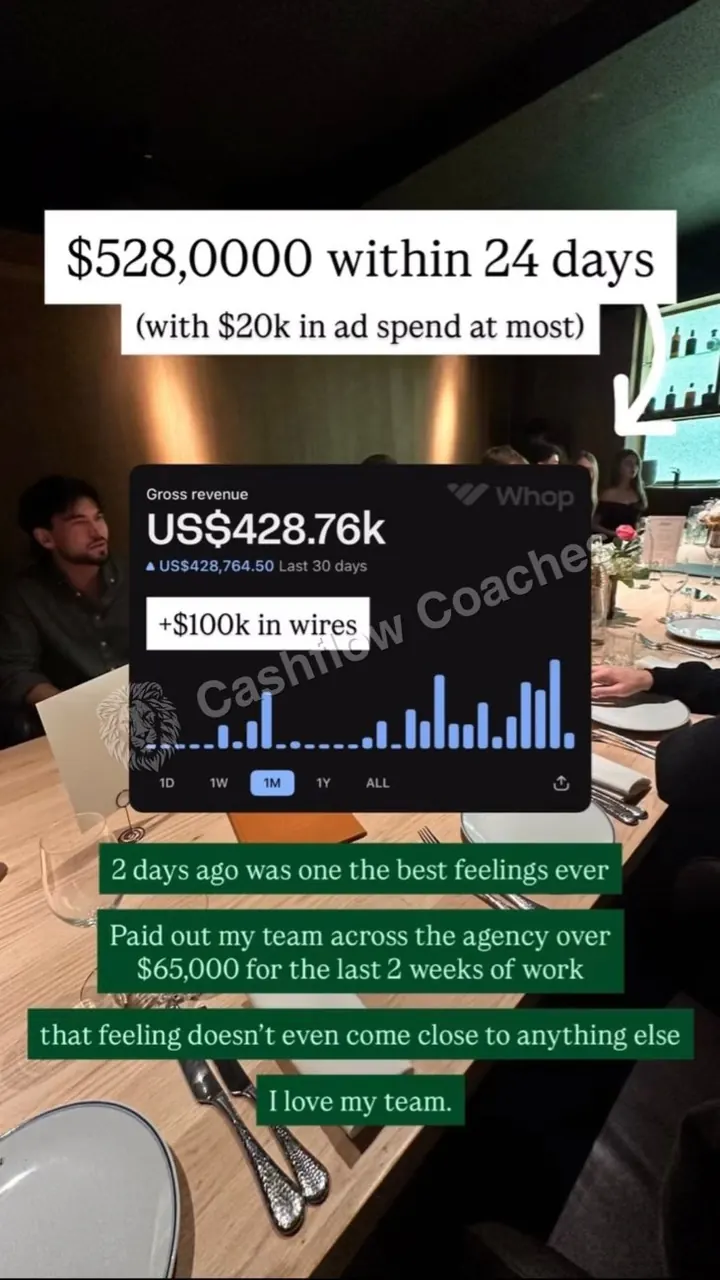 $528,000 in 24 daysNever more than $20K of ad spend
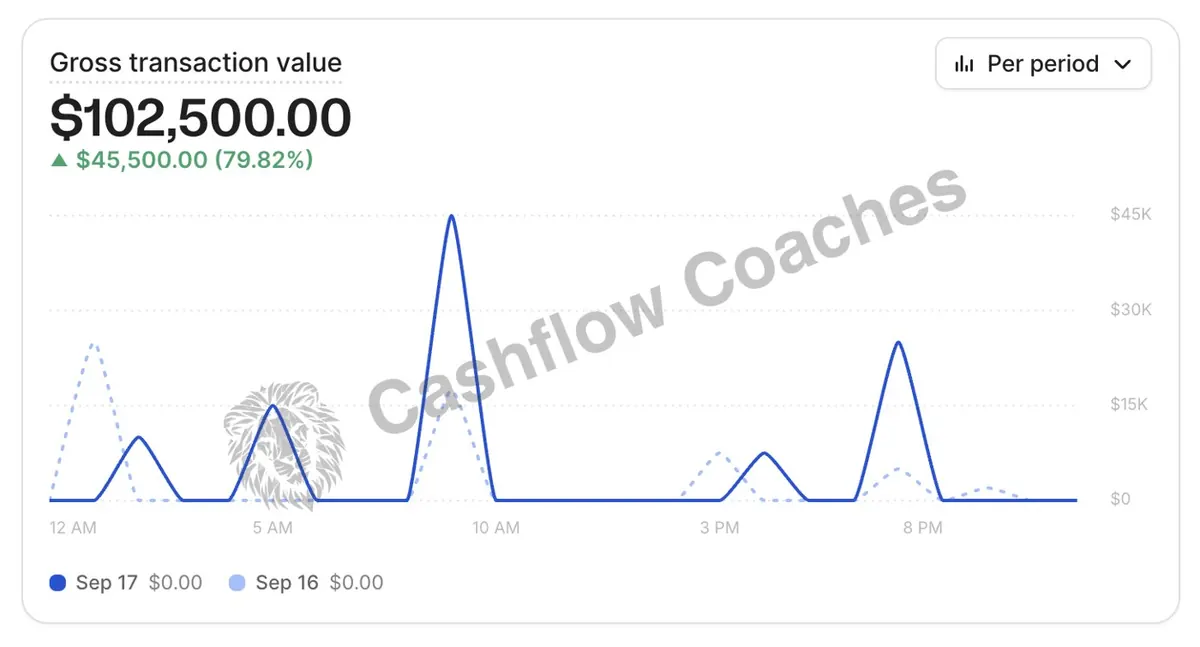 $102,500 in one dayDay 26 of Blake Mathews's webinar launch
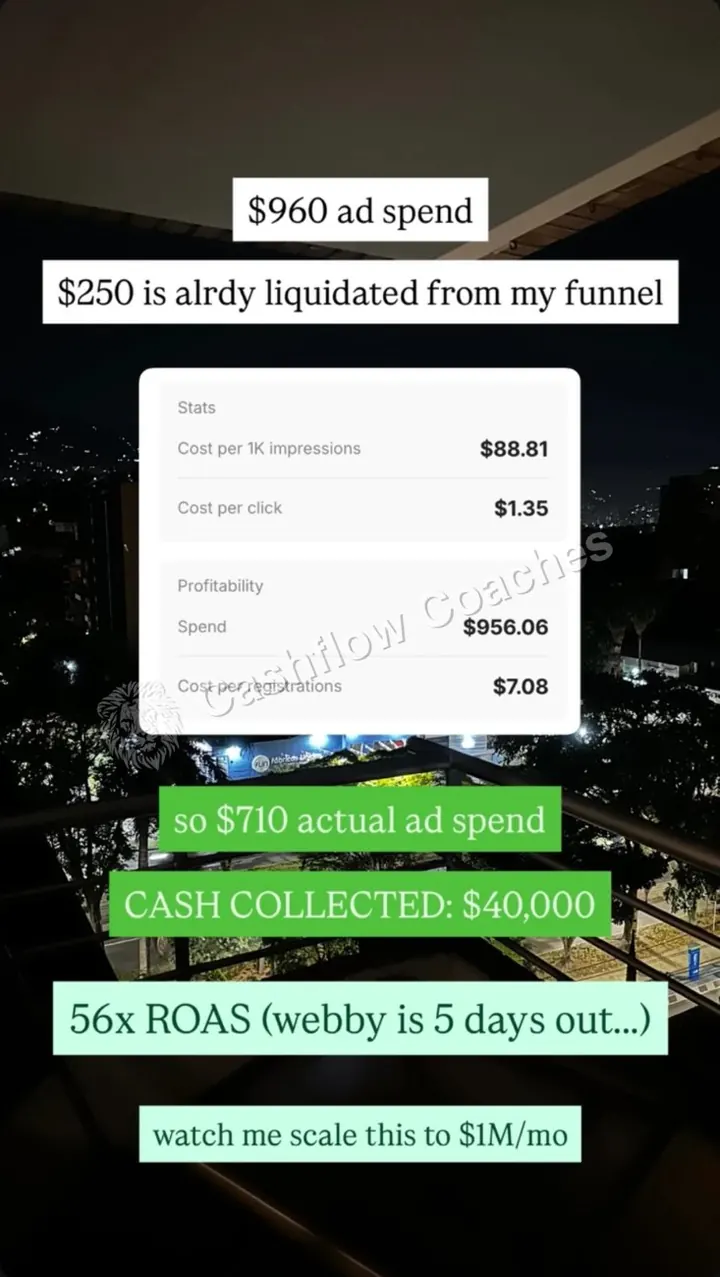 $40,000 on $710 of ads56x for Blake Mathews, 5 days before the webinar
Real screenshots from our clients and our stories. Not typical.
2Does a webinar funnel still work for high ticket offers?
Yes. Fewer people search for webinars than a year ago, but the format still turns cold strangers into high ticket buyers. By one operator's count, nearly every business doing $1M a month runs a webinar funnel.
Both are our client results, as is the $1.23M launch. Not typical. For the falling search data and when a webinar loses to a VSL, read are webinars still effective in 2026.
3What numbers should each step hit?
Other operators' numbers from high ticket webinars on cold traffic, not Cashflow Coaches results. Many plan on about $20 per registrant.
| Step | Number | Benchmark |
|---|---|---|
| Ads | Cost per 1,000 views (CPM) | $30 to $80 |
| Ads | Link click rate | about 2% |
| Sign-up page | Sign-up rate | 20% to 50% |
| Ads and page | Cost per registrant | $10 to $15 great, $15 to $20 average, over $30 rarely works |
| Reminders | Show-up rate, live | 20% average, 30%+ good, 10% to 15% means something is broken |
| Reminders | Email and text opens | emails 40% to 60%, texts 80% to 90%+ |
| Webinar | Still there at the pitch | 80%+, top presenters 95%+ |
| Pitch | Attendees who book a call | about 30% |
| Sales calls | Show rate | 70%+ |
| Sales calls | Close rate | 35%+ |
| Whole funnel | Return on ad spend | 3x to 5x going well, about 1x when it is not |
Why are the call numbers higher than in a VSL funnel? Because the webinar already did the teaching, so the people who book are warmer. Compare them with the numbers on our VSL funnel guide.
4Webinar funnel profit calculator
Put in one webinar's numbers. The defaults are made up.
Profit here is cash minus ad spend and commission, before your team's base pay and software. Under $1.20 back for every $1 of ads loses money.
Step check: which step is weakest?
Check each step against its benchmark. Fix the one that is easiest to double.
| Step | Yours | Benchmark | Read |
|---|---|---|---|
| Cost per 1,000 views | $40 | $30 to $80 | In range |
| Link click rate | 1% | 2%+ | Below |
| Sign-up rate | 20% | 20%+ | In range |
| Cost per registrant | $20 | $20 or less | In range |
| Show-up rate | 20% | 30%+ | Below |
| Still there at the pitch | 80% | 80%+ | In range |
| Booking rate | 30% | 30%+ | In range |
| Call show rate | 70% | 70%+ | In range |
| Close rate | 35% | 35%+ | In range |
If every step here is in range and growth still stalls, the leak sits outside the webinar. Find the exact bottleneck in your business.
Weakest step: link click rate. Lift it to 2% and cash goes from $14,700 to $29,400.
Want your webinar numbers sent to you?
Leave your email and we will send you this breakdown, plus the one step we would fix first.
We only use this to send your numbers and to follow up about your client acquisition. If you add a mobile, we may call or text you about it.For a whole month of ads, use the ROAS calculator. For the cost of one client, use the client acquisition cost calculator.
5Step 1: How should you run ads to a webinar?
- Make many truly different ads. Run five different angles with about five versions of each, up to 25 ads. Videos of 30 to 90 seconds, with captions, in a hook, body, call to action shape.
- Video brings warmer sign-ups. Image ads often bring cheaper sign-ups, but they show up less.
- Judge cost per qualified sign-up, not cost per sign-up. In one example, $10 sign-ups were mostly poor fits. Ads that called out income first raised the cost per sign-up but cut the cost per qualified one.
- Hold the button for a beat. One team found that showing the sign-up banner about 3 seconds after the hook started brought better traffic.
6Step 2: What goes on the registration page?
Keep it short. A common layout is a headline, a short video, a countdown and the sign-up box, with two or three scrolls of supporting text at most. Ask for name, email and mobile, so your reminders can reach them by text.
Then use the thank-you page. Tell people to add the webinar to their calendar, and give them a reason to show up. In one webinar funnel, an urgency video at the top of the confirmation page lifted show rate by 19%. The video explained why acting now paid off, using real reasons from that market.
7Step 3: How far ahead should you promote, and what reminders work?
Promote for three days at most. People who sign up on the day can show at 40% or more, while people who sign up three or more days out show at about 10% or less. Consumer webinars commonly start around 7pm Eastern. Business-to-business webinars can run midday.
Texts are for reminders. Emails carry value and the join link. Each email before the webinar answers one doubt with one real story, so showing up feels worth it. Do not text the join link. People then watch on their phones, and phone viewers stay and buy less.
| When | Channel | What it says |
|---|
Check your open rates. If reminder emails open under 40%, treat it as a deliverability problem, even when your sender score looks fine.
8Step 4: How do you keep people to the pitch?
Track how many of your peak live viewers are still there when the pitch starts. Aim for 80% or more. The best presenters hold 95%. If people leave early, the opening is usually the problem.
For length, see how long a webinar should be.
9Step 5: The webinar run of show, section by section, with timings
A webinar for a high ticket offer is not a class. It builds three beliefs in order: the method works, you are the right person to teach it, and they can do it too. Every section below does one of those jobs. If a slide does none of them, cut it.
Times are for a 7pm start: about 60 minutes of teaching, 20 minutes of offer, then questions. Replace everything in brackets. The webinar run of show writer Claude skill fills it in from your offer and your sales calls.
Welcome in. While people join, tell me in the chat: your name, where you are watching from, and what you want from tonight.
Stay to the end. I will answer every question, and I will show you how to get my help.
By the end of this you will know how to [the result] without [the thing they hate].
We will cover three things: [lesson 1], then [lesson 2], then [lesson 3].
Later I will show you how [client] got [specific result] in [time]. Stay for that one.
Before I teach you anything, here is why you should listen to me.
[Your own result, with a number.]
[Client 1: before, after, how long.]
[Client 2: before, after, how long.]
[Client 3: before, after, how long.]
[A total: clients helped, or money made for clients.]
A few years ago I was [where they are now]. [The low point.]
I tried [the old way]. It failed because [the real reason].
Then [the moment you found your method]. Now [where you are today].
I am not special. I found a method that works, and tonight I will show it to you.
Right now, [a real change in your market, with a date or a number].
Most [who it is for] still [the old way]. That is why they [the bad result].
The people who win do one thing differently: [your method in one line].
Run this shape three times, once per lesson.
The mistake: most people [the wrong approach].
What it costs: [the money, time or chances it loses them].
The shift: [the new way, in one line].
How it works: [3 to 5 steps. The what and the why, not every click.]
Proof: [client] did this and got [result] in [time].
Type YES in the chat if this makes sense.

Lesson 3 ends on the hard part: why doing this alone takes too long.
Do you feel you could start on this now? YES or NO in the chat.
From here there are three paths.
Path 1: do nothing. Next month looks like this month.
Path 2: try it alone. It can work, but [the real risks: time, mistakes, money].
Path 3: get help from someone who has done it.
Can I tell you how we help? Type YES.
[Program] helps [who it is for] get [the result] in [time], with [how you help, in one line].
Here is what you get:
[Part 1, and what it does for you.]
[Part 2, and what it does for you.]
[Part 3, and what it does for you.]
If you already know you want this, click the link in the chat and book your call now.
Book a call and join by [deadline], and you also get:
Bonus 1: [name]. [What it does for you.]
Bonus 2: [name]. [What it does for you.]
I have two more to show you. If you are ready now, the link is in the chat.
Bonus 3: [name]. Bonus 4: [name].
[Your guarantee: a specific result in a specific time, or exactly what you will do if it does not happen.]
The bonuses are for people who book by [deadline]. After that, they are gone.
Click the link, answer a few questions and pick a time today or tomorrow. On the call we go through the investment and tell you straight if it fits.
I will stay until every question is answered.
Most asked first: "[question 1]" [answer + proof]
Next: "[question 2]" [answer + proof]
Every few questions: say the offer again from a new angle, say the guarantee again, and post the booking link.
Answer the biggest group of people in the room first, then the smaller groups.
- Teach the what and the why, not every step. If they leave thinking "I could do this alone", they don't book. If they leave thinking "I get it, and I want help doing it", they do.
- Ask for the booking 5 or more times. At the offer, mid-bonuses, after the guarantee and through the Q&A. One ask at the very end loses everyone who was ready earlier.
- Get small yeses all the way through. A YES in the chat at the end of each lesson and before the offer. That is our starting point: 8 to 15 across the webinar.
- Stay in the close. Low booking rates usually trace back to short closes. Stay at least an hour, cycling objections, risk reversal and fresh pitches. A rushed, straight-to-checkout close in one example converted only 3%.
- Answer real questions in order. End with questions people actually ask in your DMs and on calls, most common first.
- Use real urgency. One team skips fake scarcity and announces a private kickoff call, right after the pitch, that only buyers can join.
10Step 6: What happens after the webinar?
Operators commonly report that sales team cleanup can double a webinar's return. Split people into two groups and give each its own emails. Setters call both.
| When | Came, did not book | Signed up, did not show |
|---|---|---|
| 2 to 3 hours after | Email: the main idea in three lines, and the booking link | Email: no guilt. Here is the replay, and the day it comes down |
| Next morning | Setter call. Attendees first. Then the replay with one lesson | Email: what is in the replay, minute by minute |
| Day 2 | Email: client results and what waiting costs | Setter call. No-shows come after attendees. |
| Day 4 | Email: the bonuses end tomorrow | Email: the replay and bonuses end tomorrow |
| Day 5 | Replay and bonuses end tonight. A replay run of 5 to 6 days with a hard end date is common. | |
| Day 6 | A 70 word heads-up: a 5 day email course starts tomorrow. Unsubscribe if you don't want it. | |
| Days 7 to 10 | One lesson a day, no pitch. Each one breaks one doubt from the webinar. | |
| Day 11 | The invitation: book a call to see if it fits | |
| Next week | An invite to the next webinar with fresh proof | |
Texts come from real phones, not bulk senders. The whole cash cycle commonly runs about 10 days, from the first ad dollar to the last dollar collected. About one in three webinar buyers watched more than one session before buying, so keep running them and keep inviting people back.
11Step 7: How do you run the sales calls?
- Book calls close in. Calls booked 4 or 5 days after the webinar show up less than calls booked for the same day or the next day.
- Leave closers room. Book closers to about 80% of their calendar, so they have time for notes and follow-up.
The show rate and pre-call sequence Claude skill writes the emails and texts between the booking and the call. To hire for those calls, read how to hire a high ticket closer and our guide to high ticket sales.
12Webinar funnel examples, page by page
Three made-up coaches, five pages each. The design stays the same. The words and timing change with the buyer.
$5,000 offer. Live every Thursday at 7pm Eastern. Ads start Monday.
One promise, a short video, a countdown, name, email and mobile.
A reason to show up, from real wins in her market.
Booking link in the chat as soon as the offer starts.
Times for today and tomorrow only.
For people who missed it or left early.
$15,000 offer. Live every Tuesday at 1pm Eastern, in work hours. Ads start Saturday.
Names the buyer in the first words, so the wrong people skip it.
An agenda helps a busy buyer block the hour.
Built around a case study, because this buyer distrusts pitches.
Revenue, team size and main goal, then the calendar in the same flow.
A short cut of the case study, not the full hour.
$3,000 offer. One recorded webinar, shown every Saturday at noon Eastern. She ran it live first.
A set time, not "watch now", so more people stay to the end.
Real questions from past classes, so it feels live.
A setter answers chat questions while it plays.
Same day or next day calls.
A real end date, then an invite to next Saturday.
13Free webinar funnel template
Want it written for your offer? The webinar funnel builder Claude skill drafts the sign-up page, the reminder emails, the run of show and the follow-up in one pass.
Building a ClickFunnels webinar funnel or a GoHighLevel webinar funnel? The template works in either. Both can host the pages. GoHighLevel keeps the calendar, texts and pipeline in the same account. The full side by side is in ClickFunnels vs GoHighLevel.
14How long should a webinar be?
About 45 to 60 minutes of teaching, then the offer, then a Q&A that runs as long as people ask buying questions. For a high ticket offer, that often adds up to 90 minutes or more. Operators disagree on the exact number, so test yours.
| View | What operators report |
|---|---|
| Keep it tight | Cut long sessions to about 45 minutes, because people leave while they wait for the offer |
| Go longer | One team stretched a 1 hour webinar to 1 hour 45 minutes with the same content, and close rates doubled |
Watch your retention to the pitch. If fewer than 80% of your peak viewers are still there when the offer starts, shorten the teaching, not the close.
15What are the disadvantages of a webinar funnel?
| Downside | What it means | How to soften it |
|---|---|---|
| Most people miss it | About 70% of registrants don't show in one operator's numbers | Same-day sign-ups, reminders and a replay with a real end date |
| Someone has to present | About an hour or more, every week | Automate once the live one works, and expect about one point less return |
| Cash comes in waves | You lose money for the 2 to 3 days of promotion, then cash spikes on the day and the day after | Size each webinar so a loss hurts but can't sink you |
| It takes time to dial in | 2 to 3 months in the worst case | Fix one step per webinar with the calculator above |
| You need people on the phones | About 10 days of setter calls after each one | Book calls for the same day or the next |
| Some buyers smell a pitch | Sophisticated audiences can read a webinar as a sales pitch | Lead with a real case study instead of a lecture |
If those costs don't fit your business, a VSL funnel runs every day without a presenter. Compare both in sales funnels.
16Live or automated webinar funnel?
Start live. Automated webinars return about one point less on ad spend, for example 3x instead of 4x. Start with one live webinar a week and only automate once it works, using set times rather than instant replays. When to switch, how to set up each, and how reminders and the offer change are on automated vs live webinars.
17How much does a webinar funnel cost to run?
Two costs: the build and the ads. A done-for-you webinar funnel from Cashflow Coaches is a one-time five-figure install, with the exact number on a call. If you want it built, see if you qualify. Ad spend is separate and paid from your own ad account. The full breakdown is in how much a webinar funnel costs.
| Ad budget question | Common budget |
|---|---|
| Per webinar | $5,000 to $7,500 |
| Per month, weekly | $20,000 to $35,000 |
| When to scale | After two profitable webinars in a row |
18Worked example: Dana fixes her ads
Dana is a made-up business coach with a $5,000 offer. She spends $5,000 per webinar and runs four a month.
| Line | The maths | Result |
|---|---|---|
| Clicks | $5,000 ÷ $40 × 1,000 views × 1% | 1,250 |
| Registrants | 1,250 × 20% | 250 ($20 each) |
| Showed up live | 250 × 20% | 50 |
| At the pitch | 50 × 80% | 40 |
| Booked calls | 40 × 30% | 12 |
| Calls that showed | 12 × 70% | 8.4 |
| New clients | 8.4 × 35% | 2.9 |
| Cash | 2.94 × $5,000 | $14,700 (2.9x) |
Her step check shows a 1% click rate, half the benchmark. Her ads are all one angle with one image. She shoots five angles, five versions each, as short captioned videos. Her click rate goes to 2%. Nothing else changes.
- 250 registrants at $20
- 12 booked calls
- 2.9x, $8,230 profit per webinar
- 500 registrants at $10
- 24 booked calls
- 5.9x, $21,460 profit per webinar
Made-up example. Next she works on show-up rate, now her weakest step.
19Webinar or VSL?
| Webinar funnel | VSL funnel | |
|---|---|---|
| Best when buyers | Need teaching and trust first | Already know the problem |
| Runs | On a set schedule, in waves | Every day, always on |
| Calls | Warmer, higher show and close | Steadier flow, cooler buyers |
| Needs | A presenter for 60+ minutes a week | One recorded video |
Many of our clients run both. Read the VSL funnel guide for the other side, and are webinars still effective for when each one wins.
20What to do this week
- Put your last webinar's numbers in the profit calculator. Write down your weakest step.
- Pick next week's webinar time. Build the reminder schedule above and load it into your email and text tools.
- Copy the run of show. Fill in your three biggest concerns from your last ten sales calls.
- Make five ad angles. Start ads no more than three days before the webinar.
- Write the 10-day follow-up: who calls whom, on which day. Book calls for the same day or the next.
- Run the webinar. Then rerun the calculator and fix one step before the next one.
Find the exact bottleneck in your business
Frequently asked questions
What is a webinar funnel?
A webinar funnel is a path from an ad to a sales call that runs through a live or scheduled online training. Ads send people to a sign-up page, reminders get them to show up, the webinar teaches and then invites them to book a call, and your setters and closers turn those calls into clients.
Are webinars still effective in 2026?
Yes, for high ticket offers sold on a call. Search interest in webinars is falling, but the format still converts. One cold-traffic webinar launch built by Cashflow Coaches went from $0 to $1,230,101 in 60 days. Results are not typical. See our full data study.
What are the 5 stages of a sales funnel?
A common way to name them is awareness, interest, decision, action and follow-up. In a webinar funnel that maps to the ad, the sign-up page, the webinar itself, the booked call, and the cleanup calls and replay emails after the webinar. More in our guide to the sales funnel.
How to create a funnel for marketing?
Start with one offer and one buyer. Then build the steps in order: an ad with one promise, a sign-up page, reminders, the webinar or video, a booking page and follow-up calls. Give each step one number to judge it by. Sign-up pages commonly convert 20% to 50%. Fix the weakest step first.
How long should a webinar be?
About 45 to 60 minutes of teaching, then the offer, then a Q&A that runs as long as people ask buying questions. Operators disagree on the exact length. Some cut to a tight 45 minutes; one team stretched 1 hour to 1 hour 45 minutes and close rates doubled. Watch retention to the pitch and test.
What are the disadvantages of a webinar?
Most registrants miss it live, someone has to present every week, cash comes in waves around each event, it can take 2 to 3 months to dial in, and you need setters calling for about 10 days after. Replays, set times, automation once it works and same-day calls soften each one.
Is there a free webinar funnel template?
Yes. The template on this page is a free 2 page PDF with no email needed. It has the seven steps with a number for each, a page-by-page checklist, the reminder schedule, the follow-up map and a 10-day cleanup plan.
Should you run a live or an automated webinar?
Start live. Automated webinars return about one point less on ad spend, for example 3x instead of 4x, so automate only once the live version is working, and use set start times rather than instant replays.
What should happen after the webinar ends?
Setters call everyone who attended but did not book, then everyone who signed up but did not show, over about 10 days, and send the replay. Operators report this cleanup can double the return from the same ad spend.

$10M+ in client results. I run Cashflow Coaches, a done-for-you marketing, sales, operations and tracking agency. We handle everything from paid ads, funnels, webinars, VSLs and Skool communities to setters, closers, ops and tracking. Two-time Skool Games winner.
Bring your webinar numbers to the call.
We find the weakest step and map the full webinar funnel for your business. If you're not a fit, we tell you what to fix first.
Book your callKeep reading: Done-for-you webinar funnelDone-for-you funnelsFunnel typesSales funnelAre webinars still effective?Webinar funnel cost
Dana is a made-up example. Her numbers show how the maths works and are not a client result. Benchmarks on this page are what other operators commonly report. They are not Cashflow Coaches results and not a promise. Every real result on this page is a past result from a specific client. None of them is typical.