
What does TAM SAM SOM mean?
Investors ask for these numbers to see if a startup can get big. A coach, consultant or agency owner needs them for a plainer reason. They tell you if your niche can carry your revenue goal, how much you can spend on ads before costs rise, and whether to raise your price or widen the niche.
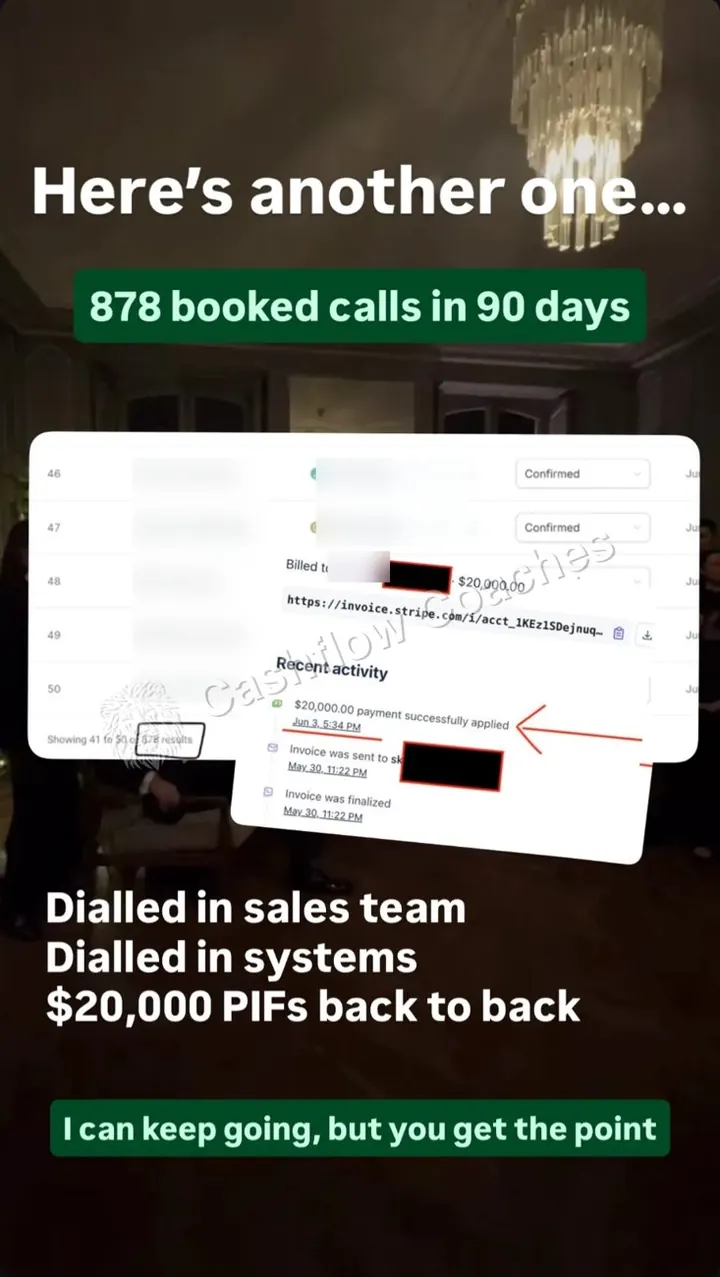 878 booked calls in 90 daysOne call funnel, one client
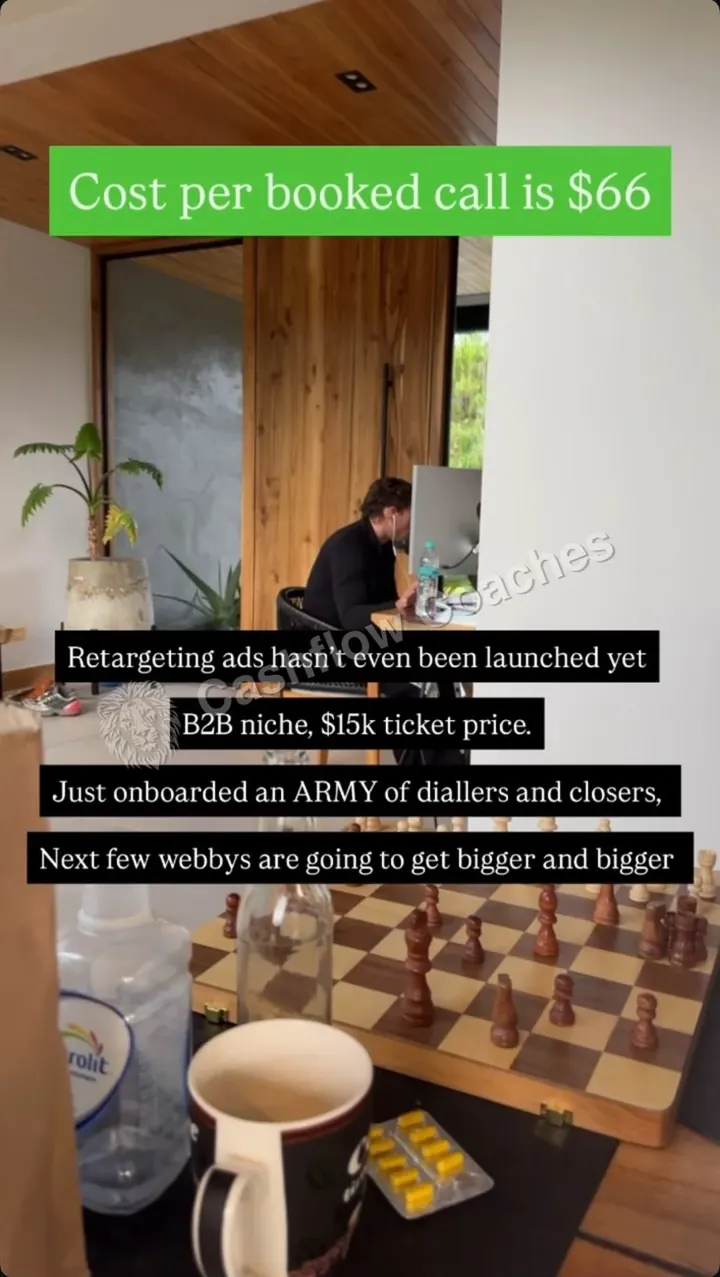 $66 a booked callBlake Mathews's $15K B2B offer, before retargeting
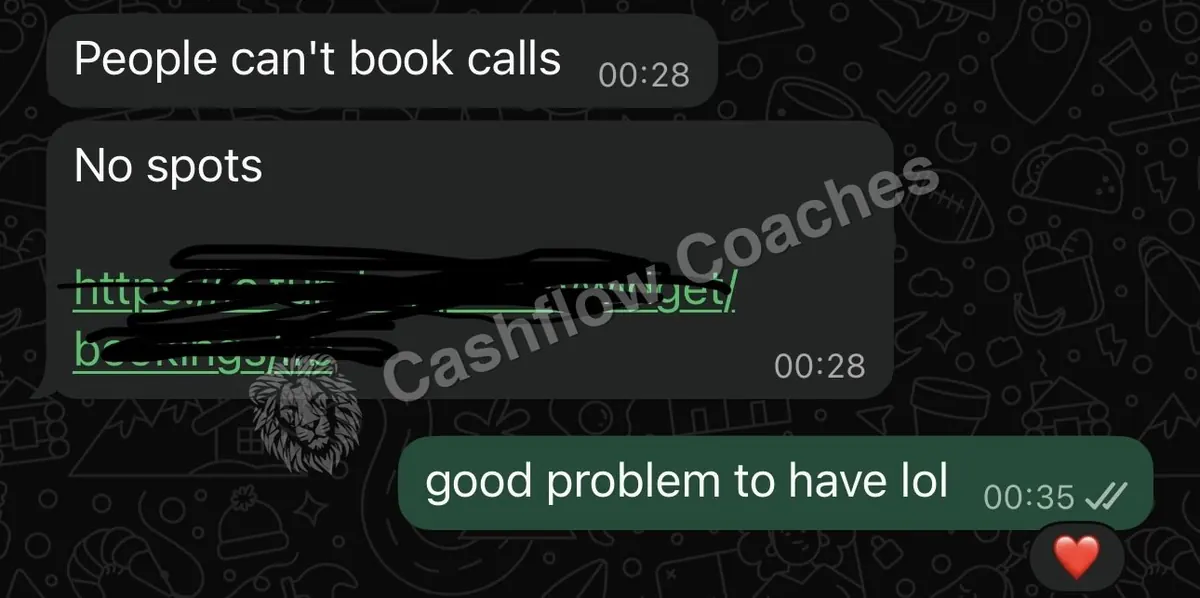 "People can't book calls. No spots."A client, a few weeks in
Real screenshots from our clients and our stories. Not typical.
TAM SAM SOM calculator
The defaults are Rina's, a made-up coach from the example below.
How do you calculate TAM, SAM and SOM?
There are two ways. Use bottom-up. Top-down numbers come from industry reports and are almost always too big to plan with.
- Starts from a report on a whole industry
- Takes a guessed share of it
- Tells you nothing about who to call or target
- Counts real buyers you could name
- Multiplies by what one pays you a year
- Gives you a list to target and an ad audience size
- Count the buyers for TAM. Everyone with the problem, in a form you can count: businesses of a type, people with a licence, members of a profession. Multiply by your yearly price.
- Filter for SAM. Cut to the ones who fit: the right revenue band, country, language, and the ones you can actually reach with the channels you run.
- Take a realistic share for SOM. A small slice of SAM over three years. Check it against how many clients your team can deliver for.
- Work backwards from your goal. Divide your monthly revenue goal by what a client is worth and see what share of SAM that needs. That number is the one that decides the niche.
Where do you find the numbers?
| Number | Where to look |
|---|---|
| Count of businesses by type | Government business counts by industry code, such as the US Census County Business Patterns tables, and the UK's business population figures. |
| Licensed professionals | State or national licensing boards. Many publish counts or searchable lists for dentists, therapists, realtors, financial advisers. |
| Members of a group | Trade associations, paid communities and conference attendee numbers. These are people already spending to grow. |
| Reachable by ads | The audience size estimate in Meta Ads Manager when you set up targeting for that buyer. |
| Size bands | Revenue or headcount filters in a B2B contact database you already use, to split the TAM into the band you serve. |
Write down where each number came from. When a number is a guess, mark it as a guess and test it with ads before you bet the year on it.
See If You Qualify
Bring your TAM, SAM and SOM from the calculator. We'll tell you if the niche can carry your goal and what we'd change first.
How big does a niche need to be for a coach or agency?
Big enough that your goal needs a small share of it. Operators commonly report wanting 60,000 or more reachable businesses before building an offer for a niche. That is not a hard floor. A higher price needs fewer buyers.
The size shows up first in your ads. Cost per lead tends to rise once cold spend passes about $10 a day for every 10,000 people in the audience. One operator with about 5,000 reachable buyers had to change ad creative almost weekly because the same people saw the ads again and again. A small market works, but it costs more effort per sale.
The other way to fail is the empty niche. Many operators warn that a niche nobody else sells to is usually unproven, not a gap. A crowded market with buyers already paying for help is safer. A small market with an average offer and no guarantee is where growth commonly stalls.
Check each niche you are weighing against five tests before you count anything:
- Pain. A problem they feel every week and cannot fix on their own.
- Money. Look for buyers with real profit, such as businesses making $500K a year or more, or people with income to match your price.
- Demand. They already pay someone for this kind of help.
- Reach. You can find them in one or two channels you know how to run.
- A result you can repeat. You have done it before, or someone in the niche clearly has.
TAM SAM SOM example for a coaching business
Rina is made up. She coaches physical therapy clinic owners to fill their schedule, at $12,000 a year.
| Step | Working | Result |
|---|---|---|
| TAM | 38,000 US clinics × $12,000 | $456M a year |
| SAM | 40% in her revenue band, 60% of those reachable: 9,120 clinics × $12,000 | $109M a year |
| SOM | 3% of SAM over three years: 274 clinics | $3.3M a year |
| Her goal | $100,000 a month, clients stay 12 months: 100 new clients a year | 1.1% of SAM a year |
Her goal needs about 1% of the clinics she can reach each year. That is a workable niche. If her SAM had come out at 2,000 clinics, the same goal would need 5% a year, and she would have to raise the price, add a second offer for the same clinics, or widen to all outpatient clinics.
To see what each client is worth over time, run the lifetime value calculator. To see what each one costs to win, use client acquisition cost and the Meta ads cost benchmarks.
What is an ideal customer profile, and how does it fit with TAM?
An ideal customer profile (ICP) describes the one buyer you build everything for. TAM counts how many of them exist. You need both. A sharp ICP with a tiny count is a hobby. A big count with a fuzzy ICP gives you ads that talk to nobody.
Write the ICP from your best clients, not your hopes. Review your best 10% and worst 10% of customers, then rewrite your marketing to attract more of the top group. Fill this in from those clients:
WHO
Role: [owner of a physical therapy clinic]
Business size: [$40K to $150K a month, 2 to 6 staff]
Where they are: [US, English speaking]

THE PROBLEM, IN THEIR WORDS
"[Our schedule is full one month and half empty the next]"
What they have tried: [a local agency, Google ads, a part-time front desk upsell]

WHY NOW
Trigger: [opened a second location, lost a referral source]

CAN THEY PAY
Price: [$12,000 a year]
Proof they already pay for this: [agency retainers, software, a marketing hire]

WHERE TO FIND THEM
Count: [about 38,000 clinics]
Channels: [state licensing lists, Meta ads, two trade groups, one conference]

WHO IS NOT A FIT
[New clinics under $20K a month. Chains with an in-house marketing team.]
The "who is not a fit" line matters as much as the rest. It becomes the filter in your application form and the first question your setter asks. See BANT and lead grading for how to turn it into a score. Want the whole profile built from your own client notes? Get the business profile builder skill for Claude.
What is a good SOM percentage?
For a service business, plan on 1% to 5% of SAM over three years. Above 5% means you need to be the clear leader in that niche. A coach with a small team rarely is, at least at first.
The more useful check is capacity. A SOM of 900 clients means nothing if your team can serve 60 at a time. Size the SOM to the clients you can deliver for, then ask if the niche is big enough to keep that many coming in each year.
When the numbers say the niche is too small, you have three moves. Raise the price, so you need fewer buyers. Sell a second offer to the same buyers. Or widen the niche one step, to a neighbouring group with the same problem. For outbound into a small, well-counted niche, B2B lead generation and getting consulting clients cover the channels. One client of ours, John Duda, sold funding education into a niche most people would call narrow. It grew to 23,403 free community members and 659 paying $697 a year. Results are not typical.
If you are not sure the market is your problem, find the exact bottleneck in your business first.
Find the exact bottleneck in your business
Frequently asked questions
What does TAM SAM SOM stand for?
TAM is total addressable market, SAM is serviceable available market and SOM is serviceable obtainable market. They go from every possible buyer, to the ones you can serve and reach, to the share you can realistically win.
How do you calculate TAM, SAM and SOM?
Count the buyers who have the problem and multiply by what one pays you a year. That is TAM. Cut it to the buyers who fit and that you can reach for SAM. Take a small share of SAM, often 1% to 5% over three years, for SOM.
What is the difference between TAM and SAM?
TAM is everyone with the problem. SAM is the part of them your offer fits and your channels can reach today. For most coaches and agencies SAM is 10% to 40% of TAM.
What is a good SOM percentage?
For a service business, 1% to 5% of SAM over three years is a sensible plan. Check it against how many clients your team can deliver for at once.
Is bottom-up or top-down market sizing better?
Bottom-up. It counts real buyers you could name and gives you an ad audience to test. Top-down starts from an industry report and is usually far too big to plan with.
How big should a niche be for a coaching business?
Big enough that your revenue goal needs about 1% to 2% of your SAM each year. Many operators want 60,000 or more reachable businesses before building an offer, though a higher price needs fewer buyers.
What is an ideal customer profile?
A short description of the one buyer you build your offer and marketing for: who they are, the problem in their words, why now, proof they can pay, where to find them and who is not a fit.
What is TAM in sales?
In sales, TAM is the full list of accounts or people who could buy what you sell. Sales teams use it to size territories and decide how many reps the market can support.

$10M+ in client results. I run Cashflow Coaches, a done-for-you marketing, sales, operations and tracking agency. We handle everything from paid ads, funnels, webinars, VSLs and Skool communities to setters, closers, ops and tracking. Two-time Skool Games winner.
Rina and the calculator defaults are a made-up example. They show how the maths works and are not a client result. Benchmarks on this page are what other operators commonly report. They are not Cashflow Coaches results and not a promise. The case study linked on this page is a past result from a specific client and is not typical.