
What should a follow up email after a sales call say?
Four things, in this order. Most follow-up emails get the order wrong. They open with the offer and never mention the prospect.
- Their goal, in their words. Copy the phrase from your call notes. "You want to get to $40K months without working weekends" lands. "You want to grow your business" does not.
- The gap they told you about. One line. What is in the way right now, as they said it.
- The worry, named plainly. Money, a partner, timing, a bad past experience. Name it and give one short answer to it.
- One next step with a date. A call time, or two times to pick from. Never "let me know".
Leave out a recap of your offer. They sat through it an hour ago. Leave out "just checking in" too. Every email should give them a reason to reply.
Subject: Your plan to get to $40K months

Hi Jordan,

Thanks for today. You told me you want to get to $40K months without working weekends, and that right now every client still comes from referrals.

You said you want time to think. That makes sense for a decision this size. Two questions usually decide it: does the plan fit your goal, and can you see yourself doing the work?

Can we put 20 minutes in the diary to finish this? I have Thursday at 2pm or Friday at 10am. Pick one and I'll send the invite.

Sam
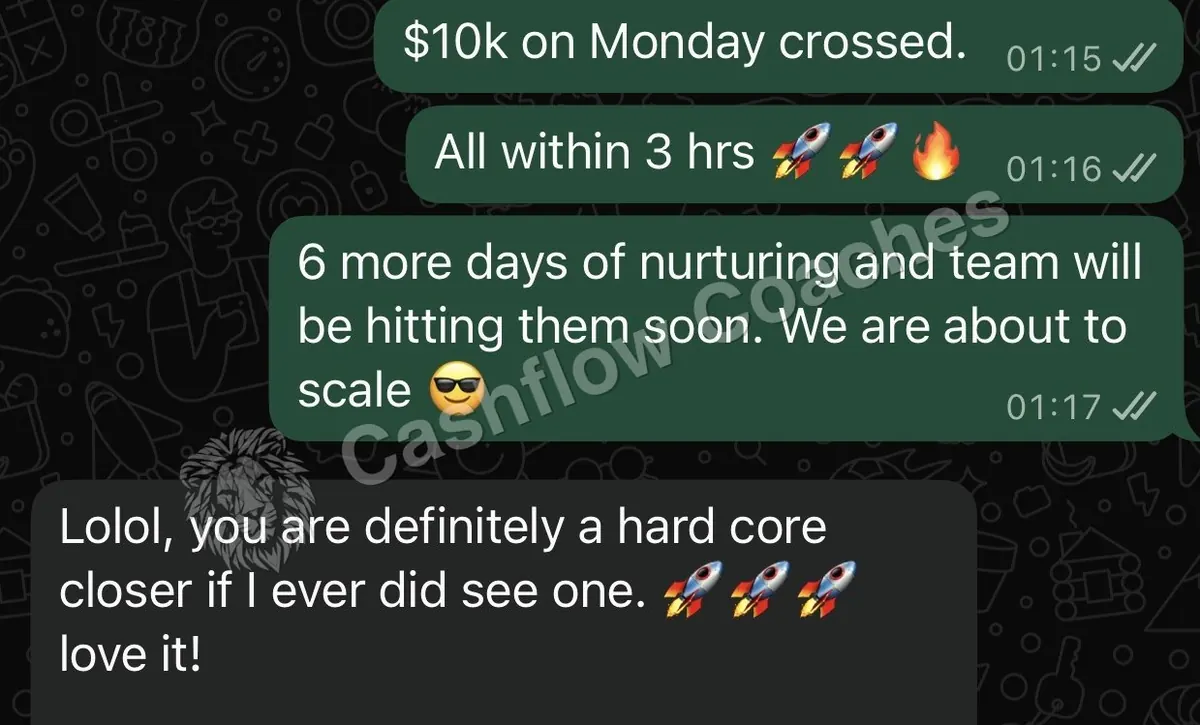 $10K in 3 hoursA client's closer, Monday morning
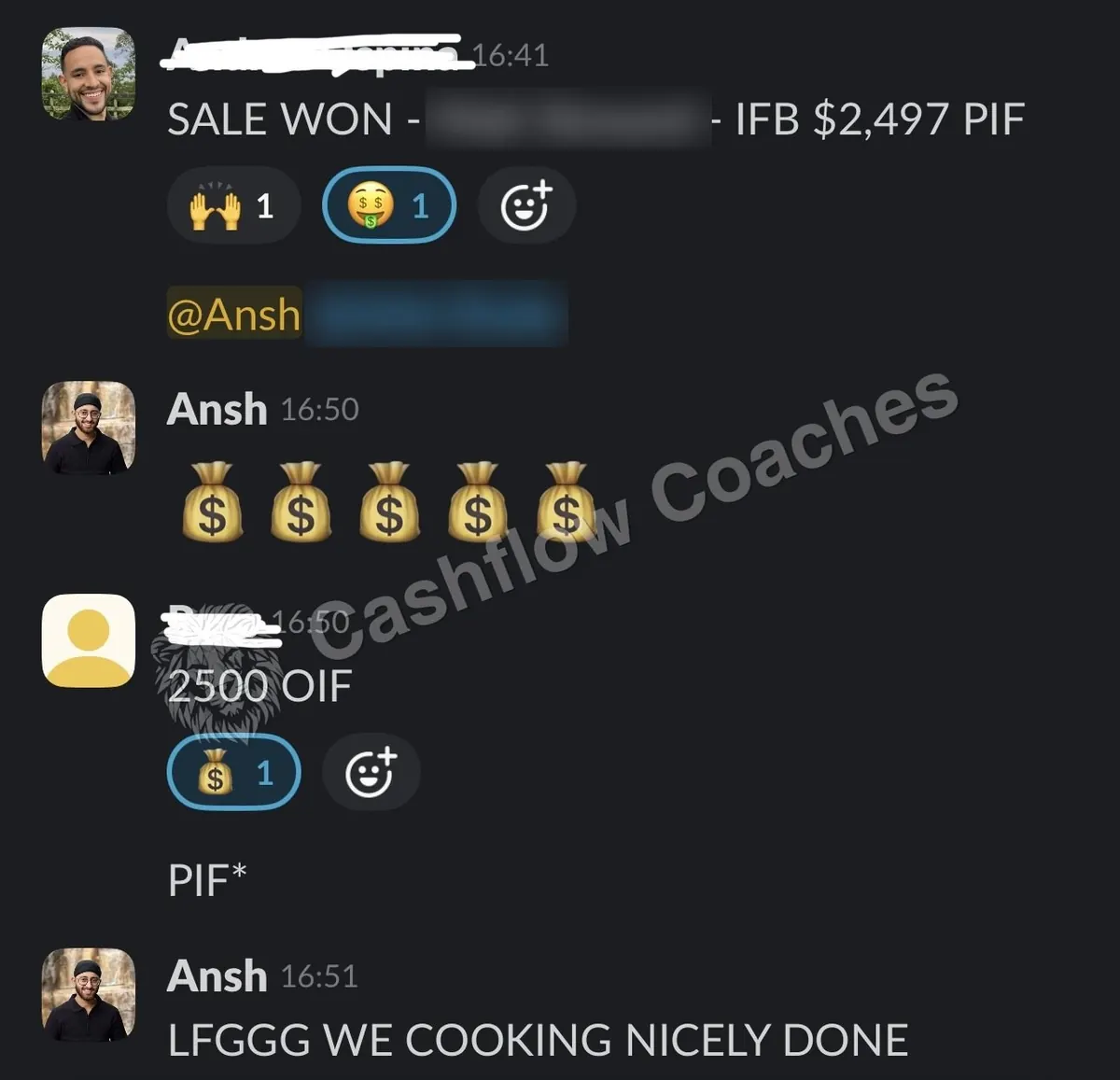 $2,497 paid in full"Sale won" in the team channel
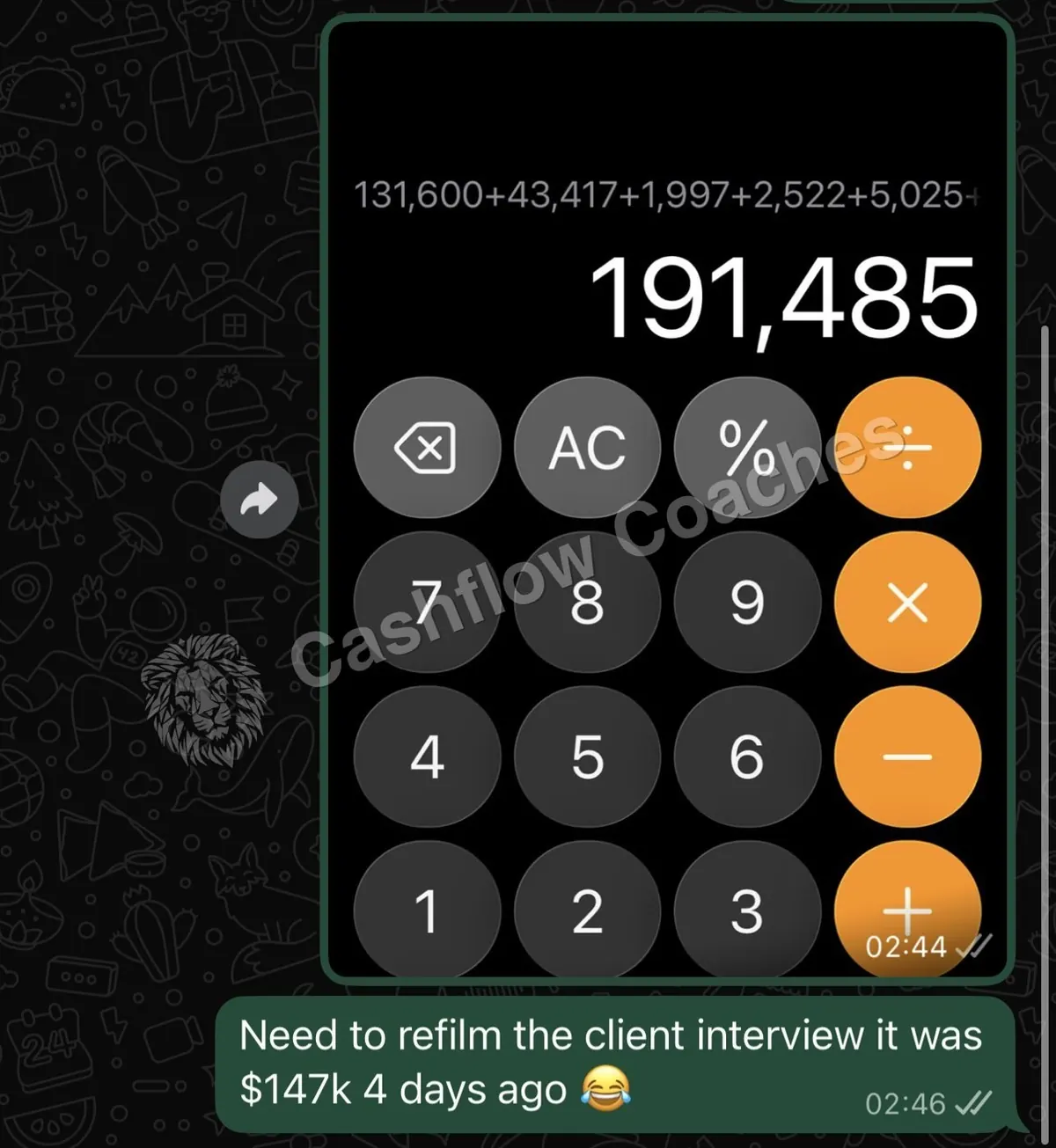 $191,485 for the month$147K of it in 4 days
Real screenshots from our clients and our stories. Not typical.
When should you send a follow up email after a sales call?
Within the hour. The call is still fresh and so is the feeling that made them book. Send the proposal within an hour of the call, or even within 30 minutes, with the payment link already in it. After that, space the emails out and stop on a set day.
The recap email: goal, gap, worry, next step.Same day, every outcome.
One piece of proof from a client who started where they are.Only if they have not replied.
The one-word question: price, timing or fit?
Close the file. Tell them you will stop, then stop.They move to your normal email list.
Phone first, email second. If they gave you a number, call before each email. The email is the backup for people who do not pick up.
How to write a follow-up email for sales, for every outcome
Pick how the call ended and fill in what the prospect said.
Subject: Our call {when}

Hi {fn},

Thanks for today. You said you want to {goal}, and that right now {gap}.

{worry}

We are booked for {when}. If anything comes up and you can't make that time, will you let me know?

{me}Subject: Before we talk {when}
Hi {fn},
Quick one before our call. {proof}. Where they started looked a lot like where you are now.
Bring any questions you still have. We will go through those first.
{me}Subject: Your plan to {goal}
Hi {fn},
Thanks for today. You told me you want to {goal}, and that right now {gap}.
{worry}
Can we put 20 minutes in the diary to finish this? I have [time 1] or [time 2]. Pick one and I'll send the invite.
{me}Subject: Someone in your spot
Hi {fn},
{proof}. They started where you are: {gap}.
Is there one question that would make this decision easier? Reply with it and I'll give you a straight answer.
{me}Subject: Quick question
Hi {fn},
When someone needs to think and then goes quiet, it is usually one of three things: price, timing or fit. Which one is it for you? One word is fine.
{me}Subject: Should I close your file?
Hi {fn},
I haven't heard back, so I'll take it the timing isn't right. I'm going to close your file so I'm not filling your inbox.
If you still want to {goal}, reply "open" and I'll send you two times.
{me}Subject: {offer}: the plan we went through
Hi {fn},
Here is the plan we walked through on the call. It is built around one goal: {goal}.
Investment: {price}. [payment link]
{worry}
I'll call you {when} to go through anything that's still open.
{me}Subject: Price, timing or scope?
Hi {fn},
When a plan sits for a few days, it is usually price, timing or scope. Which one is it?
If it's scope, I can change it. If it's timing, give me a date and I'll come back to you then.
{me}Subject: Closing this out
Hi {fn},
I'll take it the plan isn't right for now, so I'm closing it out on my side.
If you want to {goal} later this year, reply here and we'll pick it back up.
{me}Subject: Missed you today
Hi {fn},
We had a call booked for today and I didn't see you join. No problem.
Here are two new times: [time 1] or [time 2]. Reply with the one that works and I'll send the invite.
{me}Subject: Still want to {goal}?
Hi {fn},
You booked a call because you want to {goal}. Is that still true?
If yes, grab a time here: [booking link]. If not, tell me and I'll stop emailing.
{me}Subject: Last one from me
Hi {fn},
I'll leave it here so I'm not filling your inbox. If you want to pick this back up, reply "call" and I'll send you two times.
{me}Subject: What I'd do in your spot
Hi {fn},
Thanks for being straight with me today. Right now {gap}, and I don't think {offer} is the right move until that is fixed.
Here is what I'd do first: [one action]. Once that is in place, I'd like to talk again.
I'll check in on [date]. If anything changes before then, reply here.
{me}Want the full sequence built around your offer, with texts, call scripts and a reactivation campaign for old leads? Get the follow-up and reactivation sequence skill for Claude.
Why book the follow-up call before you send the email?
An email can be ignored. A time in the diary is a deadline. Book the follow-up call while you are still on the first one, even when the prospect says they will "just pay from the link". Many operators book a follow-up call every time, because a set date pushes a decision in a way a payment link does not.
Three habits make those calls happen.
- Ask for a promise. After you set the time, ask: "Will you let me know if there's any reason you can't make that time?" Then wait for the yes. Closers rate this one question among their best show rate habits.
- Put follow-ups at the edges of the day. One common setup gives each closer two follow-up slots before the first new call and two after the last one, so new calls never lose a slot.
- Stop pushing after three tries. Many teams handle the same worry up to three times on the call. If it is still there, they book the follow-up and stop pushing. Pushing past that point mostly gets you refunds.
Review these calls hardest. Operators commonly report that even good closers convert only about 60% of follow-up calls. A deal that should have closed on the first call and slid to a follow-up tells you where the closer is weak. If the same worry shows up on most calls, fix it on the call itself. Our guide to objection handling has the scripts.
See If You Qualify
Bring your last 20 calls and how they ended. We'll show you where deals slide into follow-up and what we'd fix first.
How do you write a follow-up email after a proposal?
Go through the proposal on the phone first. Never present a price or proposal by email, because on the phone you answer the questions as they come up. The email then confirms what you already agreed out loud. Many say a proposal on its own rarely persuades anyone.
A proposal email that works has four lines: the goal it is built around, the price as you say it on calls, the payment link, and the time you will call to finish.
If the proposal sits for three days, ask the question that gets a reply: "When a plan sits for a few days, it is usually price, timing or scope. Which one is it?" Each answer has a next move. Price means a payment plan or a smaller start. Timing means a date to come back. Scope means you change the plan.
How do you ask a client if they are still interested?
Ask a yes or no question and make "no" easy to say. People who would never answer "any update?" will answer "should I close your file?"
Subject: Should I close your file?

Hi [first name],

I haven't heard back, so I'll take it the timing isn't right. I'm going to close your file so I'm not filling your inbox.

If you still want to [their goal], reply "open" and I'll send you two times.

[your name]
Then close it. Move them off the sales follow-up and onto your normal email list, where they hear from you each week. That list is worth more than it looks. One coach we work with had a list nobody had emailed properly. The nurture we wrote for it brought in £16,000 in 10 days. Results are not typical.
How do I professionally say I will follow up?
Say when, and how. A vague promise reads as a brush-off from both sides. Swap these lines out of your emails today.
| Instead of | Write |
|---|---|
| I'll follow up soon. | I'll call you Thursday at 2pm. If that stops working, tell me and we'll move it. |
| Just checking in. | You said you'd talk it over at home on Sunday. How did it go? |
| Any update? | Is it price, timing or fit? One word is fine. |
| Let me know if you have questions. | What is the one question you want answered before Thursday? |
| Hope you're well. | Thanks for today. |
| Touching base on the proposal. | Here is the plan we went through. I'll call you at 2pm to finish. |
Sales follow-up email examples: a worked example
Jordan is made up. He runs a consulting firm with a $9,000 offer and takes 40 sales calls a month himself.
| Each month | Before | After |
|---|---|---|
| Calls that showed | 40 | 40 |
| Closed on the first call | 10 | 10 |
| Ended with "I need to think" | 12 | 12 |
| Follow-up call booked on the call | 0 | 10 |
| Closed later | 2 | 6 |
| Cash from follow-ups | $18,000 | $54,000 |
Before, Jordan sent a "great chatting today" email with the payment link and waited. After, he booked the follow-up on the call, sent the recap within the hour, and ran the four emails above for the two who would not book. Nothing about his offer changed. The extra $36,000 a month came from a time in the diary and four short emails.
Follow-up is one stage of the sales process. If calls are not showing up in the first place, start with your show rate and the reminder templates. Writing to people who never booked a call is a different job, covered in cold email follow up. And if you are not sure follow-up is your biggest leak, find the exact bottleneck in your business.
Find the exact bottleneck in your business
Frequently asked questions
How do you write a follow-up email after a sales call?
Open with their goal in their own words, name the gap they told you about, answer the worry they raised, and ask for one next step with a date. Keep it under 150 words and send it within the hour.
How soon should you send a follow-up email after a sales call?
Within an hour of the call. Operators commonly report sending the proposal within an hour, some within 30 minutes. Then follow up on day 2, day 5 and day 14 if they have not replied.
How do you write a follow-up email after a proposal?
Walk through the proposal on the phone first, then send a short email with the goal it is built around, the price, the payment link and the time you will call to finish. If it sits for three days, ask whether it is price, timing or scope.
How do you ask a client if they are still interested?
Ask a yes or no question that makes no easy to say, such as "Should I close your file?" People who ignore "any update?" often answer that one.
How do I professionally say I will follow up?
Give a day, a time and a channel. "I'll call you Thursday at 2pm" is professional. "I'll follow up soon" is not, because nobody can hold you to it.
How many times should you follow up after a sales call?
Four emails over 14 days works for most high ticket offers, with a call before each one if you have their number. After day 14, close the file and move them to your normal email list.
How do I thank someone after a phone call?
Start with "Thanks for today" and then say one specific thing they told you. A thank you that repeats their goal shows you listened. A generic one gets deleted.
What is a good subject line for a sales follow-up email?
Use their goal or a plain question. "Your plan to get to $40K months" and "Should I close your file?" both get opened. Avoid "Following up" and "Checking in".

$10M+ in client results. I run Cashflow Coaches, a done-for-you marketing, sales, operations and tracking agency. We handle everything from paid ads, funnels, webinars, VSLs and Skool communities to setters, closers, ops and tracking. Two-time Skool Games winner.
Jordan is a made-up example. His numbers show how the maths works and are not a client result. Benchmarks on this page are other operators' reports. They are not Cashflow Coaches results and not a promise. The case study linked on this page is a past result from a specific client and is not typical.