
Customer lifetime value (LTV) is the total profit one client brings you before they leave. Multiply what they pay per year by how many years they stay, then by your margin. Compare it to what it costs to win them: a healthy LTV to CAC ratio is 3:1 or better.
1What is customer lifetime value?
Customer lifetime value is what one client pays you, or the profit they leave you, from the first payment to the last. It is also written LTV, CLV or CLTV.
Read it next to these numbers:
| Number | What it tells you | Formula |
|---|---|---|
| Revenue LTV | Total a client pays you | paid per period × periods |
| Profit LTV | What you keep after delivery | revenue LTV × gross margin |
| CAC | What one client costs to win | sales and marketing spend ÷ new clients |
| LTV:CAC | Profit per dollar spent winning clients | profit LTV ÷ CAC |
Work out your CAC with the customer acquisition cost calculator.
 $100K+ in one week$30K of it in wires
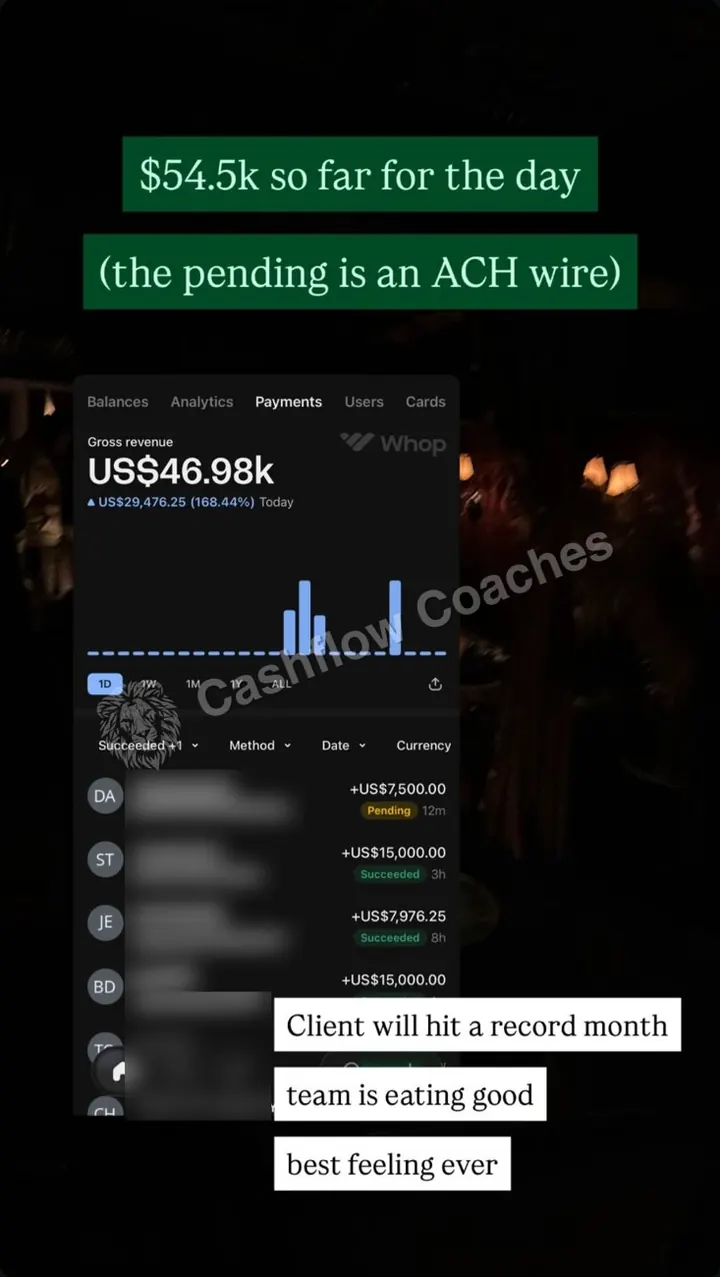 $54.5K in one dayPlus an ACH wire pending
 $30K by lunchtimeCash collected for the day
Real screenshots from our clients and our stories. Not typical.
2The LTV formula, three ways
The third is for people who sell products.
| How you sell | Formula | Example |
|---|---|---|
| Monthly retainer or membership | monthly fee × months they stay × margin | $12,000 |
| Program, then renewals | (price collected − refunds + renewals) × margin | $4,021 |
| Repeat buyer | average order × orders a year × years × margin | $192 |
Worked example: Priya's program
Priya is a made-up business coach. She sells a $6,000 program on sales calls. Some clients pay over time and a few never finish paying.
- Price collected: $6,000 × 85% = $5,100.
- Less 5% refunds: $5,100 × 95% = $4,845.
- Renewals: 30% of clients buy a $3,000 second round, so add $900 per client. Revenue LTV is $5,745.
- Margin of 70%: $5,745 × 0.70 = $4,021 profit LTV.
- She spends $1,500 to win a client. $4,021 ÷ $1,500 = 2.7:1. Close, but under 3:1.
Plan to collect only about $4,000 of a $5,000 price once payment plans, refunds and disputes come out. Using the full price makes LTV look 20% bigger than it is.
The other two rows
Retainer: $2,000 a month, 10% of clients leave each month, so the average client stays 10 months. $20,000 in revenue at a 60% margin is $12,000 profit LTV.
Repeat buyer: $80 orders, three a year, for two years is $480. At a 40% margin, profit LTV is $192.
3How do you calculate average lifetime and churn?
Average lifetime is 1 divided by monthly churn. Churn is the share of clients who leave each month. If 10 of 100 clients cancel this month, churn is 10% and the average client stays 1 ÷ 0.10 = 10 months.
| Monthly churn | Average months | Profit LTV at $2,000/mo, 60% margin |
|---|---|---|
| 5% | 20 | $24,000 |
| 10% | 10 | $12,000 |
| 15% | 6.7 | $8,000 |
| 20% | 5 | $6,000 |
| 30% | 3.3 | $4,000 |
Halving churn doubles LTV.
Marketing agencies plan around 15% monthly churn as typical. Paid online communities keep about 80% of members a month on average, and 90% or more for the best groups. Churn is highest in the first three months and drops to about 2% a month or less from month six. Judge churn on clients who have been with you a while, not only on new ones.
Without churn data, average how many months your last 20 clients stayed.
4What is a good LTV to CAC ratio?
3:1 or better, measured on profit. Each client should leave you three dollars of gross profit for every dollar it cost to win them. The extra two pay for your team, your tools and the months that go wrong.
| LTV:CAC | Read | What to do |
|---|---|---|
| Under 1:1 | Losing money | Stop adding spend. Fix price, collection or churn first |
| 1:1 to 3:1 | Thin | Raise LTV or lower CAC before you scale |
| 3:1 to 5:1 | Healthy | Scale slowly and watch CAC as spend goes up |
| Over 5:1 | Strong | You can likely pay more per client and grow faster |
3:1 is not the same for everyone. 3:1 only holds when lead generation, sales and delivery are all automated. Plan for about 6:1 with one step done by hand, 9:1 with two and over 12:1 with all three. A coach who runs every sales call and every client call sits at the top of that range.
The ratio matters more than the cheapest client: paying $500 to win a $5,000 client (10:1) beats paying $200 to win a $1,000 client (5:1). Chasing cheap leads often brings worse clients.
The CAC side is in the client acquisition cost guide.
5How much can you pay for a booked call?
Take your profit LTV, divide by your target ratio, then multiply by your show rate and close rate. That is the most one booked call can cost and still hit your target.
Max cost per booked call = profit LTV ÷ target × show rate × close rate.
Pick the target that matches how your business runs. The more you do by hand, the more each client must leave you, because your time is a cost the ratio has to cover.
Priya can pay up to about $235 for a booked call at a 3:1 target. Lift her show rate from 70% to 85% and that ceiling goes up to about $285, with no change to her ads. Use the show rate calculator to see what better reminders are worth.
The same maths tells you who to turn away: at $300 a booked call, 80% show and 25% close, one new customer costs $1,600, which a $2,000 LTV cannot carry. Plan a booked call at $100 to $300, and $500 to $1,000 for long sales cycles or much bigger tickets.
On Blake Mathews's $15,000 business-to-business offer, Cashflow Coaches got booked calls to $66 each. That is a real result and it is not typical. See how that offer was built.
Now spend against it. The spending limits tool turns this lifetime value into the most you can pay per client and per booked call, and the ROAS calculator tells you if this month's ads clear that line.
Want your numbers sent to you?
Leave your email and we will send you this breakdown, plus the one fix we would make first.
We only use this to send your numbers and to follow up about your offer. If you add a mobile, we may call or text you about it.6How do you raise LTV?
Six levers move LTV for a coach: collect more of the price, cut refunds, sell the next step, keep clients longer, raise the price and lift your margin. They are not worth the same to you.
| Lever | Profit LTV | Extra a year |
|---|
Most coaches find their top lever sits after the sale, not in the ads.
Collect the full price
Take a deposit on the call. Turn on card updates and automatic retries before a payment fails. Give one person the job of chasing every missed payment within 24 hours, with a short note from you offering help to finish it. Every point of collection goes straight into LTV.
Cut refunds
Onboard every new client within 24 hours and get them one quick win in the first week. People who see value fast rarely ask for money back. A refund rate above 5% is the number to fix before you scale, since it can also get your payment account shut down.
Sell the next step before the program ends
About a third of clients buy the next step when it is offered only at the end, and half or more when it is offered at the halfway and two-thirds marks. Put those two dates in your delivery calendar and use the same short talk each time.
[Name], we are halfway. Quick look back: you started at [where they were] and now you are at [result so far].

The next thing you will hit is [the next problem].

Clients who keep going do it with [next step]. It covers [what it adds] for [length], at [price].

Do you want to keep going after [end date], or stop where we finish? Either is fine. I would rather you decide now than on the last day.
Price the next step on what the client pays per month now. If your program is $12,000 for six months, that is $2,000 a month, so a $497 follow-on cuts what each client is worth. Build the full ladder with our guide to scaling a coaching business.
Keep clients longer
One agency operator reported average client life going from under 150 days to over 350 days after they stopped taking clients who were a poor fit. Churn is often fixed on the sales call, with better qualifying. Churn peaks in the first three months, so check in hard at day 30, 60 and 90. Offer a yearly plan at about a 17% discount, because yearly members cancel less.
Raise the price
Raise price 10% to 15% at a time and judge it over the next 30 calls. If close rate holds, keep it.
One operator reported a low-ticket funnel at 0.4x return on ad spend at launch that showed about 8x a year later, as buyers moved up over 6 to 9 months. Day-one ROAS can undercount what a client is worth. LTV catches it. If your LTV is healthy and growth is still stuck, find the exact bottleneck in your business.
7How does a SaaS LTV calculator work?
Software and memberships use the same idea with different words: average revenue per account (ARPA) times gross margin, divided by monthly churn.
A $100 a month plan at an 80% margin with 4% monthly churn: $100 × 0.80 ÷ 0.04 = $2,000. Use the retainer tab above for this.
Recurring businesses commonly track net revenue retention too: starting revenue plus upsells minus churn, divided by starting revenue. Under 100%, the business shrinks unless new clients keep coming in.
8What to do this week
- List your last 20 clients: what each one paid in cash, and how many months they stayed.
- Divide cash received by price sold. That is your real collection rate. Put it in the calculator at the top.
- Set your ceiling for a booked call in section 5 and compare it with what you pay now.
- Run the lever tool, copy your plan and start on lever one.
- Book the next-step talk at the halfway and two-thirds marks for every current client.
Want us to build the funnel that fills your calendar at that ceiling? See if you qualify.
Find the exact bottleneck in your business
Frequently asked questions
How do you calculate the lifetime value of a customer?
Multiply what a client pays per period by how many periods they stay, add renewals and upsells, take off refunds, then multiply by your gross margin. A client paying $2,000 a month for 10 months at a 60% margin has a lifetime value of $20,000 in revenue and $12,000 in gross profit.
What is the formula for customer value?
The common formula is average purchase value times purchases per year times years as a customer times gross margin. For a monthly service it is monthly fee times gross margin divided by monthly churn.
How do you calculate average customer lifetime?
Divide 1 by your monthly churn rate. If 10% of clients leave each month, the average client stays 1 divided by 0.10, which is 10 months. You can also average how many months your past clients actually stayed.
What is a good LTV to CAC ratio?
3 to 1 is the usual floor: each client leaves three times what it cost to win them, in gross profit. Under 1 to 1 you lose money on every client. If your sales or delivery is done by hand, aim higher, because those costs grow as you scale.
Should LTV use revenue or profit?
Use gross profit when you compare it with CAC. Revenue LTV looks bigger, but delivery costs come out of it. This calculator shows both so you can see the gap.
How much can I spend to get a new client?
Divide your profit LTV by your target ratio. With $12,000 of profit LTV and a 3 to 1 target, you can spend up to $4,000 to win a client. Multiply that by your show rate and close rate to get the most you can pay for one booked call.
What is the fastest way to raise customer lifetime value?
For most coaches it is after the sale: collect more of the price, cut refunds and offer the next step at the halfway and two-thirds marks of the program. Operators commonly report that half or more of clients buy the next step when it is offered mid-program, against about a third when it is offered only at the end. The lever tool on this page ranks each one on your own numbers.
Is LTV the same as loan-to-value?
No. Loan-to-value is a mortgage and lending number: the loan divided by the value of the property. This page is about customer lifetime value, which is what a client is worth to a business.

$10M+ in client results. I run Cashflow Coaches, a done-for-you marketing, sales, operations and tracking agency. We handle everything from paid ads, funnels, webinars, VSLs and Skool communities to setters, closers, ops and tracking. Two-time Skool Games winner.
Bring your numbers to the call.
We look at your LTV, your CAC and what you pay per booked call, and map what we would fix first. If you're not a fit, we tell you what to fix on your own.
Book your callKeep reading: CAC calculatorClient acquisition costROAS calculatorWhat is ROASHigh ticket salesFind your bottleneck (quiz)Sales funnel builders compared
Priya is a made-up example. Her numbers show how the maths works and are not a client result or a benchmark. The ratio bands are planning targets. The $66 booked call is a past result from one client. It is not typical or a promise of what you will get. Your results depend on your offer, your price, your ad spend and your sales team.