
1What is speed to lead?
The meaning of speed to lead is how long a new lead waits before a real person, or a real message, reaches them. Some people call it lead response time. Track it like you track ad costs.
The clock starts when the lead acts. It stops at your first real contact. An auto email that nobody reads does not stop it.
| Lead source | Clock starts when | Clock stops when |
|---|---|---|
| VSL or ad opt-in | They submit the form | First text or call from your team |
| Webinar sign-up | They register | First text or call |
| Application | They start or finish it | First call |
| Booked call | They pick a time | A setter confirms by phone |
| DM or comment | They message you | A real reply |
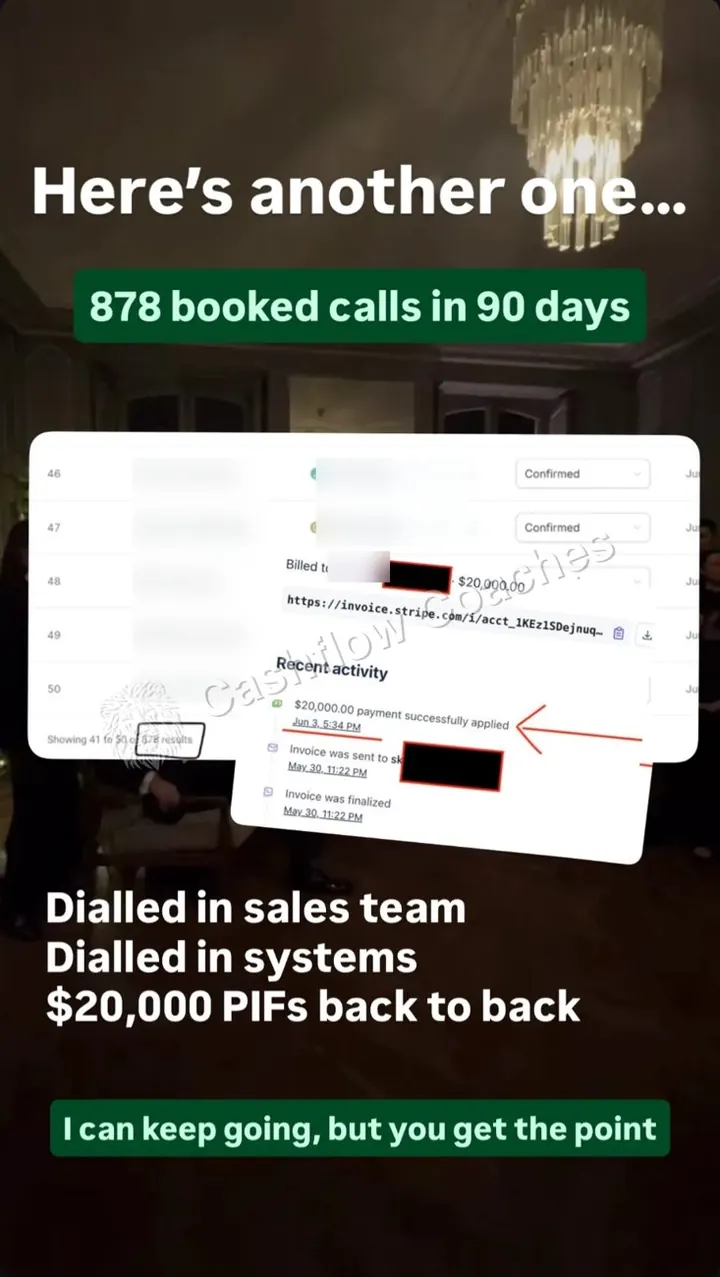 878 booked calls in 90 daysOne call funnel, one client
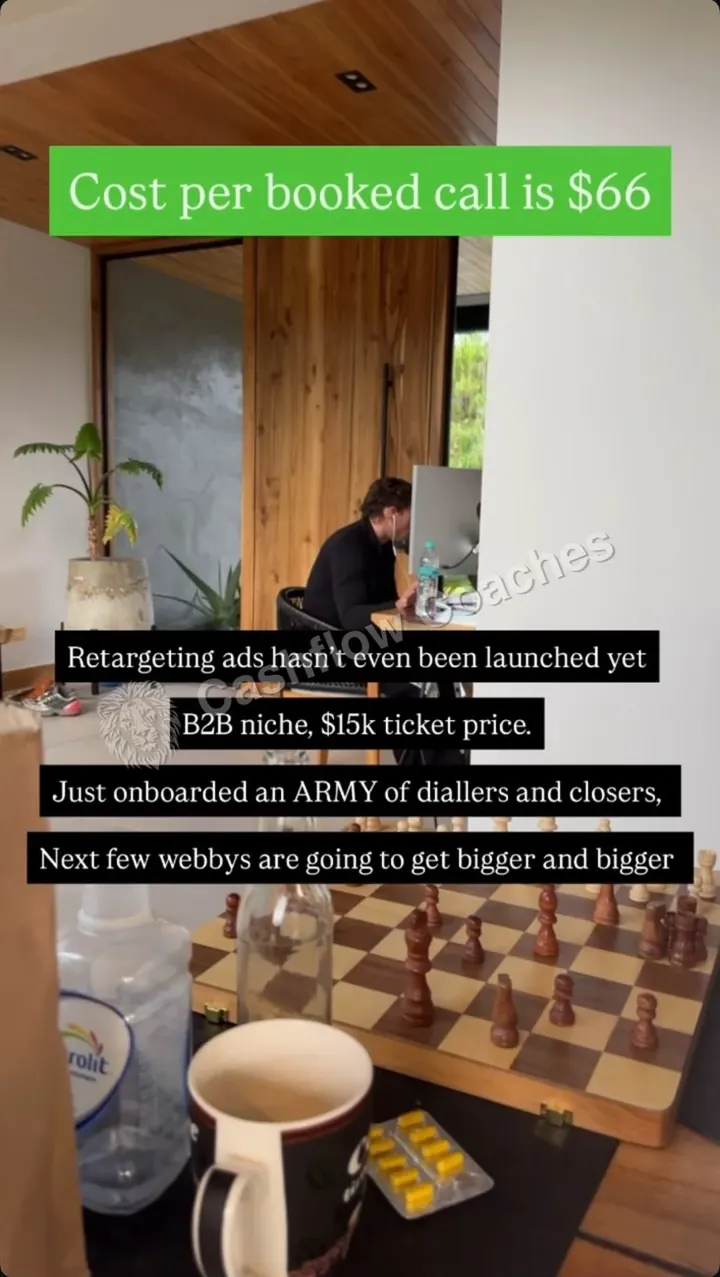 $66 a booked callBlake Mathews's $15K B2B offer, before retargeting
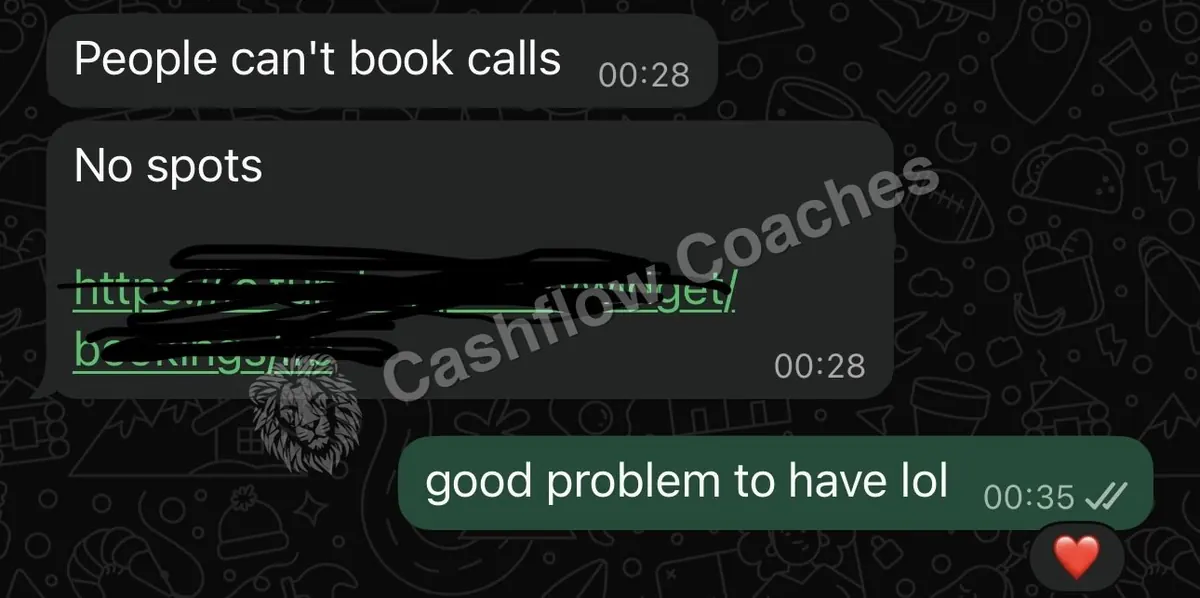 "People can't book calls. No spots."A client, a few weeks in
Real screenshots from our clients and our stories. Not typical.
2Speed to lead statistics: what do operators report?
These speed to lead stats are other operators' numbers, not Cashflow Coaches results.
| What they report | Number |
|---|---|
| Contact within 60 seconds | About a 391% higher chance to close |
| Wait more than 5 minutes | The chance to close falls about 80% |
| Who wins the deal | About half of buyers go with the first business to respond |
| Practical target | Text in 2 to 3 minutes, call in 5 to 7 |
| Leads who book on their own | About 10%; setters pull the rest through |
| Calls booked by setters | 60% to 70%, by calling every opt-in and half-done application |
| Warm leads who have not booked | 8+ texts and 8+ calls over two weeks; most bookings come after 5 to 8 follow-ups |
Operators commonly report that "bad lead" complaints are often lead-handling problems. Check your speed before you blame the ads.
3Why does speed to lead matter more for high ticket offers?
Each lead costs more. A booked call often costs $100 to $300, and up to $1,000 for big tickets. A lead left alone for a day is money spent for nothing.
Interest is highest right after the form. A call five minutes later reaches someone who still remembers why they signed up.
Speed also lifts show rate. Call back within a minute or two and book the sales call for today or tomorrow. Calls booked 3 to 4 days out show up less. See sales call show rate.
4Speed to lead calculator: what is slow follow-up costing you?
You need two contact rates. Pull your last 50 leads and split them into called within 5 minutes and called later. The share you reached in each group is its rate. No data yet? Keep the made-up example numbers.
Counts first conversations only, not follow-up.
The sales process calculator finds your leakiest step from lead to cash. The client acquisition cost calculator shows what each client costs.
5The 5-minute speed to lead system
Text first, so your call is not from an unknown number. Send it from the number the setter will call from. In our view a text from a real phone gets read, and a bulk short code gets treated like spam.
Auto text and setter alert. The lead gets a short text. The setter gets a ping with name, phone and source.Automatic
Text from a real phone. Send it within 2 to 3 minutes.Setter
First call. Under 5 minutes. Two or three questions, then book today or tomorrow.Setter
Voicemail and a missed-you text. Then a second call within the hour.Setter
Email with one short case study. Matched to what they said on the form.Automatic
Keep going. 8+ texts and 8+ calls over two weeks, about every other day.Setter
Monthly win-back. Leads who never book go into a monthly reactivation message.Automatic
What changes by lead source?
| Lead source | First move | Goal of the first call |
|---|---|---|
| VSL opt-in | Call even if they have not finished the video | Book the sales call |
| Half-done application | Call within minutes | Finish it on the phone and book |
| Webinar sign-up | Text, then a short call | Get them to show up live |
| Just booked a call | Call now, even if the call is later in the week | Confirm, qualify, cut no-shows |
| DM or comment | Reply in minutes | Move to a call or a booking link |
| Night or weekend | Auto text at once | Call as soon as a setter is on |
Who do you call first when leads pile up?
Two setters, nine new leads at 10am. Work them in this order.
- Half-done applications. They are the warmest leads. Flag them to setters within minutes.
- Opt-ins under 5 minutes old. Every minute they wait costs more than any older lead.
- New bookings. A confirm call while they still remember booking.
- Webinar attendees who did not book. Then registrants who never showed.
- Day 2 to 14 follow-ups. Whatever time is left.
Booked calls then need reminders. Copy them from appointment reminder templates.
6The first-contact scripts
Hi {fn}, it's {me} from {biz}. Saw you just {did}. I'll give you a quick call in a few minutes from this number.Hi [first name], it's {me} from {biz}. You just {did} a few minutes ago, right?
Great. I won't keep you long. Two quick questions so I can point you to the right next step.
1. What made you look at this today?
2. Where are you now with wanting to {goal}, and where do you want to be?
Sounds like a call with {closer} makes sense. I've got [today at time] or [tomorrow at time]. Which works better?Hi [first name], {me} from {biz}. You just reached out about wanting to {goal}. I'll text you from this number so you have it. Talk soon.Just tried you, {fn}. Is now a bad time? Reply with a better time and I'll call then.Hi {fn}, it's {me} from {biz}. Got your details. Our team is offline right now. I'll call you at {when} tomorrow. Reply here if another time is better.Day 2: Still keen to {goal}, {fn}?
Day 4: Quick one. Want me to save you a spot with {closer} this week?
Day 6: {cs} had the same worry. Here's what happened: [link]
Day 8: Should I close your file, or still interested?
Day 11: Got two times open tomorrow. Want one?
Day 14: Last one from me. Reply "yes" and I'll call.Want this built around your own offer, with the setter's full call and the GoHighLevel steps? Get the speed to lead and setter script skill for Claude.
For the full call, with objection handlers, see the appointment setter script.
See If You Qualify
Bring your numbers from the calculator. We'll tell you what we'd fix first in your follow-up.
7How do you set up speed to lead in GoHighLevel?
One workflow per lead source. Menu names can shift between updates, so match these to what you see in your account.
- Pick the trigger. Automation, then Workflows, then a new workflow. Use Form Submitted, Survey Submitted or Facebook Lead Form Submitted, filtered to one form.
- Put the lead in your pipeline. Add Create or Update Opportunity, stage "New lead".
- Assign a setter. Add Assign to User. The call step rings whoever owns the lead.
- Send the first text. Add Send SMS with script 1 above.
- Alert the setter. Add Internal Notification by text or app push with name, phone and source.
- Ring the setter. Add the Call action. It rings the assigned user with a short whisper message. They press a key and the lead is dialed.
- Follow up if no answer. Add a Wait of 5 minutes, a missed-you text and a second call. Then waits and texts on the day 2 to 14 rhythm.
- Stop when they reply or book. Turn on Stop on Response in workflow settings. Remove booked leads with an appointment workflow.
- Cover nights and weekends. Send the text at once. Put the call behind a Wait with a time window so it fires when the team is on.
Test it on your own phone before you turn on ads. Submit the form and time it.
8Humans, AI or both?
Both. AI sends the first text in seconds, at any hour. Humans are better on the phone.
A human setter tops out at about 100 to 200 DMs a day, while an AI setter with a human approving replies can work a whole CRM. See AI appointment setter for the split.
9How do you measure and report speed to lead?
| Number | How to get it | Look at it |
|---|---|---|
| Median minutes to first call | Lead created time vs first outbound call | Weekly |
| Share of leads called within 5 minutes | Same export, count under 5 | Weekly |
| Contact rate | Leads reached by a person within 24 hours | Weekly |
| Booking rate | Booked calls ÷ leads reached | Weekly |
| Leads with zero touches | Filter: no outbound call or text | Daily |
Use the median, not the average. One lead called three days late wrecks an average.
To get the column: export last month's leads with the created time and the first outbound call time, subtract one from the other in a spreadsheet, and paste the result here.
Run a 15 minute check every morning. Pull every lead with zero touches and every lead with no activity for two days. Give each one a named setter and a time today. In our experience most leads that go cold are never refused. Nobody called them.
At small volume, week-to-week swings are mostly noise. Judge it over a month.
10Worked example: Tessa gets to five minutes
Tessa is a made-up business coach with a $5,000 offer. Her VSL funnel brings 400 leads a month. Her setter calls the next morning, about 45 minutes on average in work hours.
| Line | The maths | Result |
|---|---|---|
| Reached now | 400 × 35% | 140 |
| Reached at 5 minutes | 400 × 60% | 240 |
| Extra booked calls | 100 × 30% | 30 |
| Extra calls that show | 30 × 60% | 18 |
| Extra clients | 18 × 20% | 3.6 |
| Revenue left on the table | 3.6 × $5,000 | $18,000 a month |
She builds the GoHighLevel workflow above, adds the auto text, and moves her setter's shift to cover evenings. Same ads, same price. After a month, her own two contact rates show whether it worked. If your monthly figure looks like hers, see if you qualify to have the follow-up built and run for you.
One of our B2B clients, Blake Mathews, with diallers working every lead, paid $66 per booked call on a $15,000 offer. Not typical.
11What to do this week
- Export your last 50 leads. Write down the median minutes to first call.
- Split them into under 5 minutes and over. Work out both contact rates.
- Put those numbers in the calculator. Share the monthly figure with your team.
- Build the GoHighLevel workflow for your biggest lead source.
- Paste scripts 1 to 5 into the workflow and your setter's notes.
- Submit your own form at 9pm on a Saturday. See what happens.
Then run the check below. If your speed is already fine and calls still do not turn into clients, find the exact bottleneck in your business.
Find the exact bottleneck in your business
Frequently asked questions
How quickly should you respond to a lead?
Within five minutes. Text within 2 to 3 minutes and call within 5 to 7. Faster is better. Inside a minute is ideal when you can do it.
What is speed to lead?
Speed to lead is the time between a lead showing interest, like filling out a form or a booking request, and your first real contact with them. It is also called lead response time.
What is a good speed to lead time?
Under five minutes for the first call, with a text before it. The chance to close falls about 80% once you wait past five minutes.
Should you text or call a new lead first?
Text first, then call. The text tells them who is calling, so they are more likely to pick up a number they do not know.
What about leads that come in at night or on weekends?
Send a text at once that says when you will call, then call as soon as your team is on. Some operators sell seven days a week, because many people book on weekends.
Does speed to lead matter after someone books a call?
Yes. Call every new booking right away, even if the call is later in the week, to confirm the time and answer questions. It cuts no-shows.
Can AI handle speed to lead?
AI is good at the first text, any hour, in seconds. Most teams still have a person call. Use AI to send and sort, and people to talk.
What is lead generation in sales?
Lead generation is getting people who might buy to raise a hand, such as an opt-in, an application or a booked call. Speed to lead starts where it ends. The clock runs from that hand-raise to your first real contact, and every hour of delay wastes what the lead cost you.
What is speed to lead software?
Any tool that texts a new lead and rings your setter the moment a form comes in. Most CRMs can do it. In GoHighLevel it is one workflow with a Send SMS step and a Call step.

$10M+ in client results. I run Cashflow Coaches, a done-for-you marketing, sales, operations and tracking agency. We handle everything from paid ads, funnels, webinars, VSLs and Skool communities to setters, closers, ops and tracking. Two-time Skool Games winner.
Bring your speed to lead numbers to the call.
We look at your lead flow and response time and show you where the follow-up leaks. If you're not a fit, we tell you what to fix first.
Book your callKeep reading: Sales call show rateAppointment setter scriptAppointment reminder templatesHow to hire appointment settersOutsourced sales teamFind your bottleneck (quiz)
Tessa is a made-up example. Her numbers show how the maths works and are not a client result. Benchmarks on this page are what other operators commonly report. They are not Cashflow Coaches results and not a promise. Every real result on this page is a past result from a specific client. None of them is typical. GoHighLevel steps were written on 23 October 2026. Menu names can change.