
How do you write a cold email follow up?
Every follow-up has to give the reader a new reason to reply. "Bumping this to the top of your inbox" gives them none. A new angle, a short case, a free resource or an easy question each give them one.
Three rules carry most of the result. Keep each email under 80 words. Ask for something small, like "want me to send it?", never a 30-minute call in the first email. And stop when you said you would.
Subject: question about {co}

Hi {fn},

Saw {trigger}. When that happens, {problem}.

We {result}.

Worth a look at how? I can send {resource}.

{me}Subject: (reply in the same thread)
Hi {fn},
One more thought on this. The firms that fix it fastest do one thing first: [one specific tip they can use today].
Happy to send {resource} if it's useful.
{me}Hi {fn}, it's {me}. I sent you a note about how {problem}. Is that on your list this quarter, or have you got it covered?
If voicemail: Hi {fn}, {me} here. I emailed you about {co}. I'll send one short note after this so you have my number. No need to call back.Subject: how a firm like {co} did it
Hi {fn},
Quick story. We {result}. Before that, they had the same problem: {problem}.
Want me to send {resource}? Yes or no is fine.
{me}Hi {fn}, {me} again. Last time I'll call about this. If fixing how {problem} matters this year, I can show you what worked in 15 minutes. If not, tell me and I'll leave you alone.Subject: no pitch in this one
Hi {fn},
Here's [a one-page checklist or short video] we use with firms like {co}. It covers the first three things to fix when {problem}.
Free to use. No reply needed.
{me}Subject: this quarter, next year, or never?
Hi {fn},
Quick one. Is fixing this a this-quarter thing, a next-year thing, or a not-for-us thing?
One word is fine.
{me}Subject: (reply in the same thread)
Hi {fn},
I haven't heard back, so I'll guess this isn't a priority right now, or I've got the wrong person.
If someone else at {co} looks after this, who should I talk to? If not, no problem. I'll close the loop here.
{me}Subject: (reply in the same thread)
Hi {fn},
I haven't heard back, so I'll guess this isn't a priority right now, or I've got the wrong person.
If someone else at {co} looks after this, who should I talk to? If not, no problem. I'll close the loop here.
{me}Subject: (reply in the same thread)
Hi {fn},
I haven't heard back, so I'll guess this isn't a priority right now, or I've got the wrong person.
If someone else at {co} looks after this, who should I talk to? If not, no problem. I'll close the loop here.
{me}The fields you fill in matter more than the wording around them. "Why them, why now" has to be something true you can see, like a job post, a new office or a launch. If you cannot fill it in, fix the list before you touch the email.
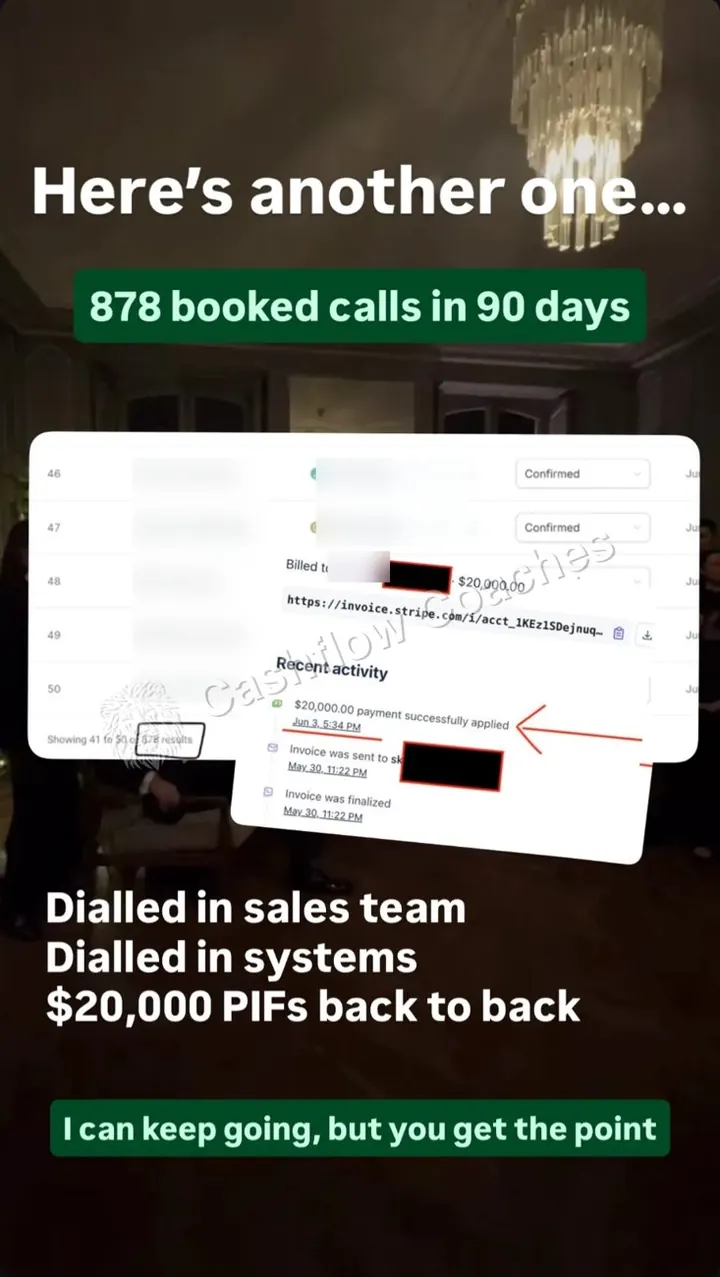 878 booked calls in 90 daysOne call funnel, one client
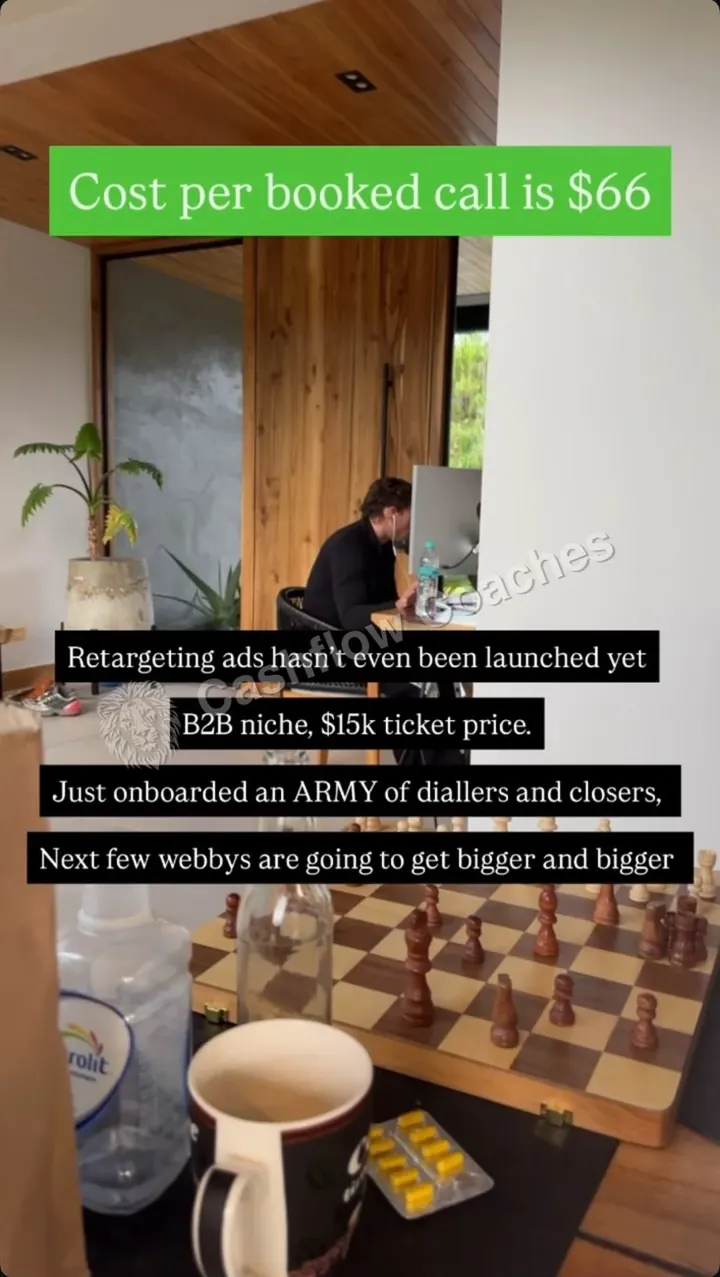 $66 a booked callBlake Mathews's $15K B2B offer, before retargeting
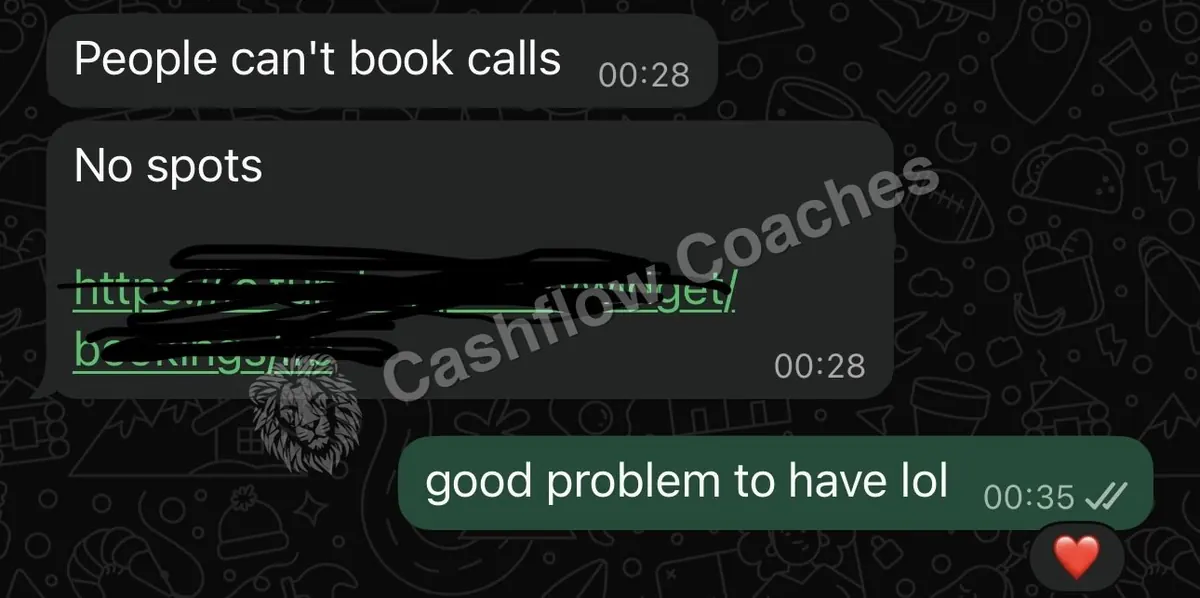 "People can't book calls. No spots."A client, a few weeks in
Real screenshots from our clients and our stories. Not typical.
When should you follow up on a cold email?
Two to three days after the first email, then space the gaps out. Reply in the same thread for the first follow-up so they see the context. Start a new subject when you change the angle.
| Touch | Day | Thread | What it adds |
|---|---|---|---|
| 1. Opener | 1 | New | Why them, the problem, one result, a small ask |
| 2. New thought | 3 | Same | One tip they can use without you |
| Call | 4 | Phone | A real voice, one question |
| 3. Short case | 7 | New | A firm like theirs, before and after |
| 4. Resource | 12 | New | A checklist or short video, no ask |
| 5. One-word question | 18 | New | An answer that takes five seconds |
| 6. Close the loop | 25 | Same | Permission to stop, or the right person |
Send on weekday mornings in their time zone. After the last touch, leave them alone for at least a month. Then come back with a new angle and a new case, or not at all.
How many follow-up emails should you send?
Four to six emails, with a call or two if you have the number. Fewer and you give up before most people have even seen your name. More and you are just noise.
Run the maths before you pick a volume. A typical B2B cold email month gets about 2% replies, and about 20% of each step moves on to the next.
| Step | Rate | Per month |
|---|---|---|
| Contacts emailed | 10,000 | |
| Emails sent, 3 per contact | 30,000 | |
| Replies | 2% | 200 |
| Positive replies | 20% | 40 |
| Calls booked | 20% | 8 |
| New clients | 20% | 2 |
Two clients from 10,000 people. That works when one client is worth $20,000 or more a year. It does not work for a $500 offer. Adding the phone changes the numbers a lot. Teams that run both get about 5 to 10 meetings a month from cold email and 50 to 60 from cold calling, at a similar cost to win a client.
Why are my cold email follow ups not getting replies?
Usually it is one of four things, in this order.
- Your emails land in spam. A common story: someone sends 400 cold emails from their main domain on day one, gets it blacklisted, then sends 50 a day for a year with no replies and never finds out why. Never send cold email from the domain your clients and invoices use.
- Too much volume per inbox. Spread 1,000 emails a day across about 20 domains and 40 inboxes, so one burned domain does not take the rest down. With links in the email, some keep it to about two cold emails per inbox per day.
- The wrong list. Results depend on the list more than the copy. A bought list of job titles is cold in every sense. A directory where your buyers list themselves, or a group they paid to join, is full of people who are actively trying to grow.
- Nothing worth replying to. Reply rates can go from 1% to 3% after adding a personal first line that points to a similar case study, a short video link, and a P.S. naming about 30 clients.
It also got harder. Cold email results fell as sending tools got cheaper and AI pushed volume up. The inbox is more crowded than it was, so generic follow-ups get ignored faster.
See If You Qualify
Bring your sending numbers and reply rates. We'll show you whether cold email, calling or ads is the cheaper way to fill your calendar.
How do you follow up on a follow-up email without being annoying?
Change what you offer each time. Saying the same thing again, louder, gets you marked as spam. Each touch should be readable on its own, by someone who never saw the last one.
| Annoying | Worth a reply |
|---|---|
| Just bumping this up. | One more thought: the firms that fix this fastest start with [tip]. |
| Did you see my last email? | Quick story about a firm your size. |
| Let me know when you have 30 minutes. | Want me to send the 2-minute video? Yes or no is fine. |
| Following up again. | Is this a this-quarter thing, a next-year thing, or never? |
| I'll keep reaching out. | I'll close the loop here. Who else should I talk to? |
The same rules work after a sales call. Our sales call follow up email templates cover prospects who have already spoken to you.
Cold email follow up sample: a worked example
Dana is made up. She runs a six-person bookkeeping firm for marketing agencies. A client pays her $3,000 a month and stays about two years. She emails 1,200 new agency owners a month.
| Each month | One email | 5 emails + 2 calls |
|---|---|---|
| New contacts | 1,200 | 1,200 |
| Emails sent | 1,200 | 6,000 |
| Replies | 14 | 48 |
| Positive replies | 3 | 10 |
| Calls booked | 1 | 4 |
| New clients | 0 to 1 | 1 |
One new client a month at $3,000 for two years is $72,000 of fees from one month of sending. To send 6,000 emails a month she needs about 280 a weekday. At about 25 per inbox, that is 12 inboxes on six spare domains, warmed up for a few weeks before the first send.
When someone replies, the clock starts. Call them the same day. Our guide to speed to lead has the first-contact scripts, and the discovery call guide covers what to ask on the call itself.
Is cold email the right way to get B2B clients?
It is the cheapest way to start, and the hardest to scale. It works best with a done-for-you offer, a clear result and a list you can trust. For the full picture of channels and costs, see B2B lead generation and how to get consulting clients. For what happens once the meeting is booked, read B2B sales.
Ads can do the same job at scale. For Blake Mathews, a B2B client on a $15,000 offer, ads and a webinar booked sales calls at $66 each, before retargeting was switched on. Results are not typical. If you are not sure whether outreach or something else is holding you back, find the exact bottleneck in your business.
Want the follow-up sequence, the texts and a campaign to wake up old leads, built around your offer? Get the follow-up and reactivation sequence skill for Claude.
Find the exact bottleneck in your business
Frequently asked questions
When should you follow up on a cold email?
Two to three days after the first email, in the same thread. Then around day 7, day 12 and day 18 with a new angle each time, and close the loop by about day 25.
How many times should you follow up on a cold email?
Four to six emails in total, plus one or two calls if you have the number. After the last one, wait at least a month before you try a new angle.
How do you follow up on a follow-up email?
Add something new each time: a tip, a short case study, a free resource or a one-word question. Never send "just bumping this", because it gives the reader no reason to reply.
How long do people take to respond to cold emails?
Most people who reply do it within a day or two of the email that caught them. That is why the follow-ups matter: each new touch is a new chance to arrive on a day they have time.
How do I start a cold email?
Start with them, not you. Open with something true and specific about their business, like a job post or a launch, then name the problem that usually follows it.
What is a good reply rate for cold email?
Operators commonly report about 2% replies on B2B cold email, with about 20% of those positive. A strong first line and a relevant case study can push it higher.
Should the follow-up be in the same thread?
The first follow-up, yes, so they see the context. Later touches with a new angle can use a new subject line, and the last one can go back to the original thread.
How do you end a cold email sequence?
Close the loop politely. Say you will stop, and ask who else at the company handles it. That email often gets more replies than the ones before it.

$10M+ in client results. I run Cashflow Coaches, a done-for-you marketing, sales, operations and tracking agency. We handle everything from paid ads, funnels, webinars, VSLs and Skool communities to setters, closers, ops and tracking. Two-time Skool Games winner.
Dana is a made-up example. Her numbers show how the maths works and are not a client result. Benchmarks on this page are what other operators commonly report. They are not Cashflow Coaches results and not a promise. The case study linked on this page is a past result from a specific client and is not typical. Check the email rules in the countries you send to before you start.