
1What is an info business?
Info business: a business that sells what someone knows, packaged as a course, coaching program, community, membership, mastermind or done-with-you program, instead of a physical product or hourly service.
Info product: one packaged piece of know-how sold online, such as an online course, ebook, template pack, recorded workshop or membership.
An info product is one thing you sell. An info business is everything around it: the offer, the funnel, the sales process, delivery and support.
Coaches, consultants, trainers and experts who sell a program that teaches people to get a result all run info businesses, whatever they call it.
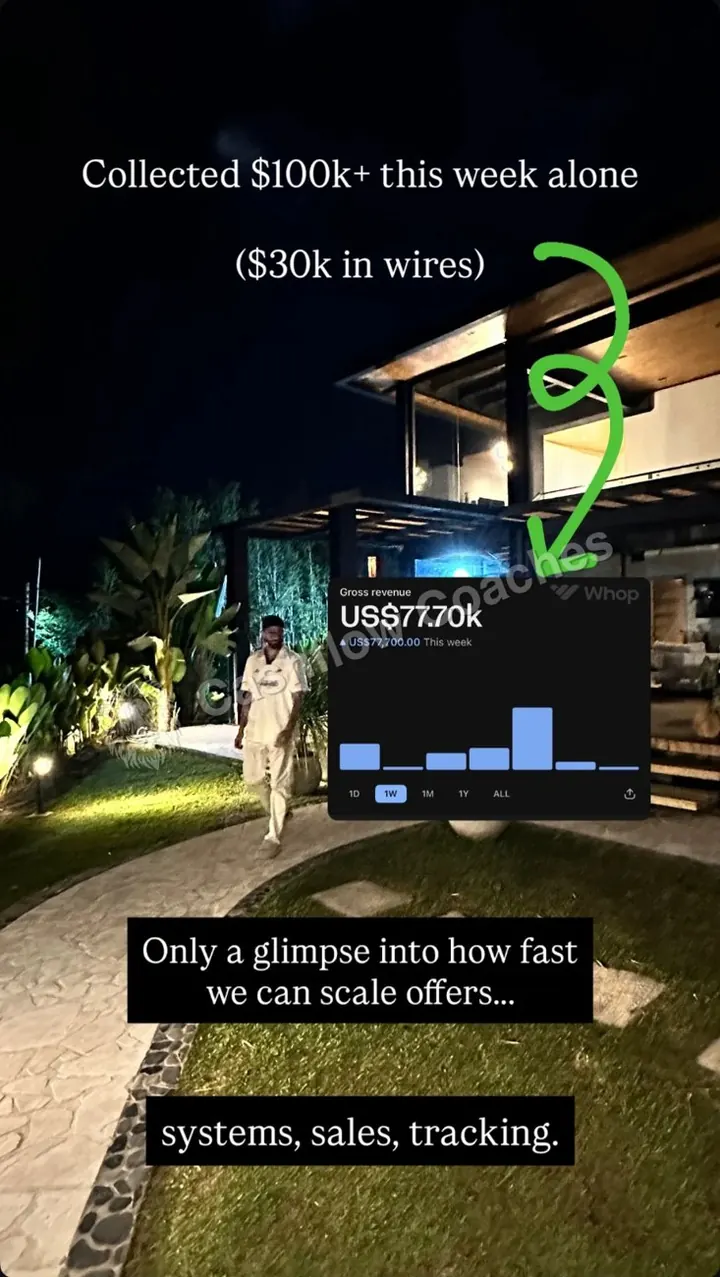 $100K+ in one week$30K of it in wires
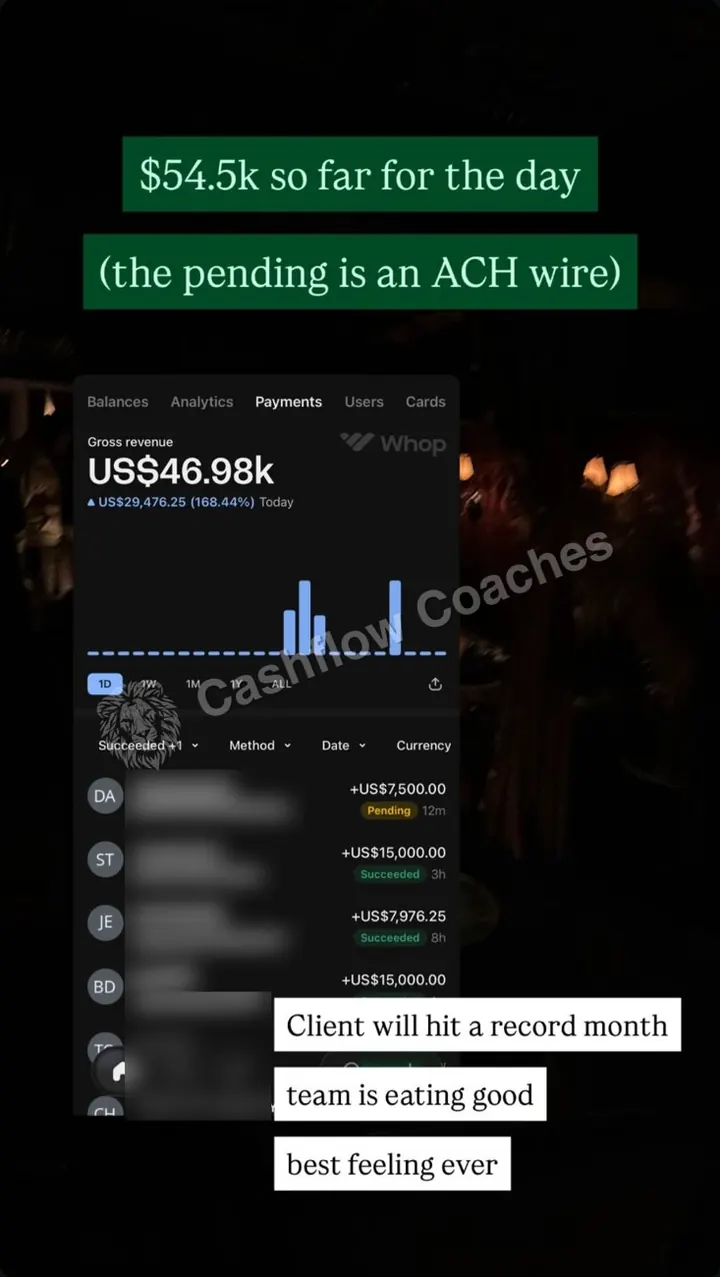 $54.5K in one dayPlus an ACH wire pending
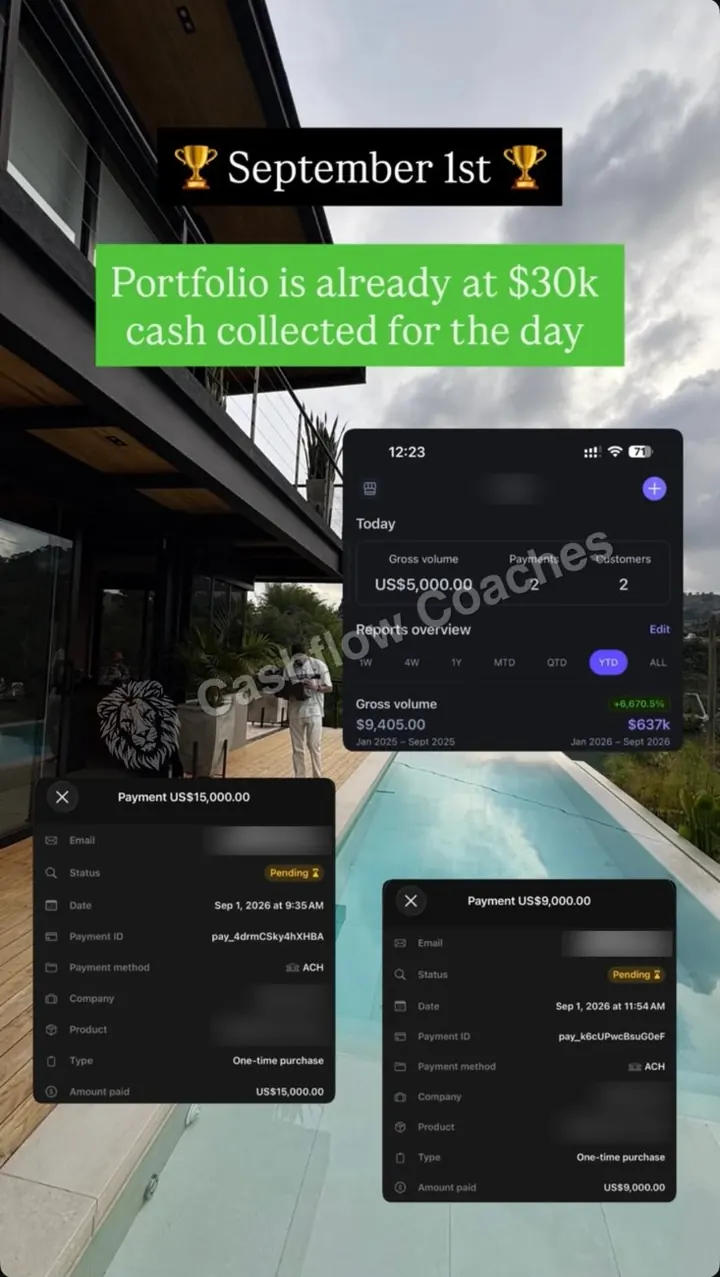 $30K by lunchtimeCash collected for the day
Real screenshots from our clients and our stories. Not typical.
2How does an info business make money?
These six models are the digital products that sell for experts. Most info businesses that grow end up running two or three of them as a ladder.
| Model | What the buyer gets | Price point seen | How it usually sells |
|---|---|---|---|
| Low ticket product | Ebook, template, short course | $27 is a common example | Sales page, under about $300 |
| Online course | Recorded lessons, no live help | $497 to $997 in one operator's program | Video sales letter with checkout, up to about $1,000 |
| Paid community | Group, lessons, calls, monthly fee | About $50 a month is the average on Skool | About page, free group or content |
| Group coaching program | Lessons plus live group calls | One operator started at $500, then $1,000 to $5,000 | Video sales letter or a sales call |
| High ticket coaching or done-with-you | Direct help, feedback, often some work done for them | High ticket usually starts at $5,000 | Sales call, above about $1,000 |
| Mastermind | Small group of peers, high access | $1,500 to $10,000 a month at one operator | Application and a sales call |
These are reported price points, not rules. Your price depends on the result you sell and the proof you have. For selling at the top of this table, read how high ticket sales works.
Why price matters so much
1,000 buyers at $100 needs about 84 sales a month, while 40 buyers a year at $2,500 needs about 3 a month. A higher price needs far less marketing for the same money, but it needs real results and a way to sell on a call.
3Which info business model fits you?
Answer five questions to get a starting model and the funnel that usually sells it.
4How many sales do you need at each price?
| Price | Sales a month | Sales a day | Booked calls a month |
|---|---|---|---|
| $27 | 1,852 | 61.7 | No calls |
| $497 | 101 | 3.4 | No calls |
| $2,500 | 20 | 0.7 | 114 |
| $5,000 | 10 | 0.3 | 57 |
| $10,000 | 5 | 0.2 | 29 |
Revenue here is sales, not cash collected after payment plans and refunds.
Low ticket math rarely works without huge traffic: at $27, $10,000 a month takes about 371 sales, or roughly 18,550 clicks at a 2% conversion rate. So most info businesses that grow add a higher priced offer sold on a call.
5How do you scale an info business?
- Prove the result. A product is proven when 15 to 30 clients got a consistent result in the time you promise. Before that, ads only scale refunds.
- Price for the funnel you can run. Under about $300, a sales page. Up to about $1,000, a video sales letter with checkout. Above that, a sales call.
- Build one funnel that books buyers. For high ticket, that is usually a webinar funnel or a VSL funnel into booked calls.
- Hire people to sell. Setters call leads fast. Closers run the calls. Read how to hire appointment setters, how to hire a high ticket closer and when an outsourced sales team works.
- Give every buyer a next step. A ladder of offers, built below, so people who finish move up instead of leaving. Skool groups are a common home for it: see how we grow Skool communities.
- Watch refunds and margins. A refund rate over 5% is a reason to stop scaling.
Not sure which of these steps is holding you back? Find the exact bottleneck in your business in 2 minutes. The full playbook, stage by stage, is in how to scale a coaching business. For the system that brings in clients every week, see the client acquisition system.
6How do you move buyers from a low ticket offer to a high ticket one?
Build three tiers, give each its own promise, and only offer the next one after the buyer gets the first result.
| Tier | What they get | The promise |
|---|---|---|
| On your own | Course or short program with a set end date | A first, smaller result, fast |
| Done with you | Calls, feedback and accountability every month | A bigger result, with help |
| Done for you | You or your team do the work | The biggest result, fastest |
- Keep the promises separate. If the course promises the full result, nobody needs the next tier. Ask: if a buyer got everything the course promises, would they still want more help?
- Give the low tier a set end date. 6 weeks, not "watch at your own pace". An open-ended course never finishes, so the buyer is never ready for the next step.
- Wait until they are done. Offer the next tier after the end date and a first result, not in week one.
- Ask permission three ways at once. A check-in call from the person who sold them, an email with a yes and a no link, and small retargeting ads to past buyers.
- Respect the no. People who click no get help getting more from what they bought. Many come back later.
Fill in your offer to get the three promises, the email and the call script. Tier names and prices are in the high ticket offer builder skill.
On your own: {course} helps {who} {small} in {weeks}.
Done with you: {mid} helps {who} {big}, with calls and feedback every month.
Done for you: {top} does the work, so {who} {big} without doing it themselves.Subject: How did {course} go?
Hi [first name],
You've had {weeks} with {course}. I hope you now {small}.
Two quick things.
If it helped, I'd love a short reply telling me what changed. It helps the next person decide.
And a question. Some people want help to go further, and {big}. That's what {mid} is for. Want to hear how it works?
Yes, tell me more: [link]
No, I'm good for now: [link]
Either answer is fine.
[Your name]Hi [first name], it's {rep}. We spoke when you joined {course}. How did it go? Can you {small} now?
[Listen. If something is not working, help first and end the call.]
That's great to hear. Can I ask you something? Some people at your stage want help to {big}. Would you be open to me telling you about the next step? No pressure either way.
[If yes] It's called {mid}. The difference is you get calls and feedback every month, so you {big} faster. Want me to book you a time with [closer] to see if it fits?
[If no] No problem at all. If that changes, I'm here. Glad {course} helped.When a buyer clicks yes, alert the sales team at once and send them to a page with a short video on the next tier and a booking link.
See If You Qualify
Bring your offer, your price and how you sell today. We will tell you what we would fix first.
7How much does an info business keep?
More than most businesses, but less as you add a team and ads.
| Item | Operators report |
|---|---|
| Profit margin at $100K a month | About 85% |
| Profit margin at $250K a month | 70% or more |
| Cash you actually collect on a $5,000 price | About $4,000, after payment plans, refunds and disputes |
| Sales team pay | 10% to 15% of the price |
| Card fees | About 3% |
| Refund rate to stay under | 5% |
| Monthly retention in paid Skool groups | About 80% on average, 90% or more for the best |
Some operators say the plain course plus calls plus community model is wearing out, because buyers have tried it, and are moving to more hands-on, done-with-you help. Others give the lessons away free and charge for feedback and help putting them to work.
8Worked example: Tom picks his model
Tom is a made-up bookkeeping coach. He teaches small business owners to keep their own books and cut their accountant's bill. He wants $50,000 a month.
Option A: a $497 course
- 101 sales a month, about 3 a day.
- Needs a big audience or a lot of ad traffic.
- Little of Tom's time per buyer.
Option B: a $5,000 program
- 10 sales a month.
- About 57 booked calls at a 70% show rate and a 25% close rate.
- Weekly group calls plus reviews of each buyer's books.
Tom has fewer than 1,000 followers and has helped 18 clients get a clean set of books. He picks option B. He runs a weekly webinar, hires a setter to call every sign-up, and takes the calls himself until he is booked solid. Then he hires a closer. The $497 course becomes a cheaper first step for people who are not ready, with a 6-week end date and the upgrade email above.
If you already have the offer and the proof, see if you qualify for a build like Tom's.
9Info business funnel results: 350+ communities scaled
Past results from specific clients. Not typical.
See the full $1.23M case, or start at how Cashflow Coaches works.
10What to do this week
- Write your offer in one sentence: who it is for, the result, and how long it takes.
- Count the clients you have got that result for. Under 15, focus on getting more before ads.
- Run the model chooser and the sales table with your real goal.
- Pick one price and the funnel that matches it.
- If you sell more than one offer, write the three promises in the ladder tool and check that no two overlap.
- If you sell on calls, block the hours to take them and write a short booking form.
- Set a refund rate limit of 5% and track it from your first sale.
Find the exact bottleneck in your business
Frequently asked questions
What is an info business?
An info business sells what someone knows instead of a physical product or hourly service. It is packaged as a course, coaching program, community, membership, mastermind or done-with-you program and sold online, usually through a funnel and often a sales call.
What is an info product?
An info product is one packaged piece of know-how sold online, such as an online course, ebook, template pack, recorded workshop or membership. An info business is the whole system around it: the offer, the funnel, sales and delivery.
What are examples of info products?
Online courses, ebooks, templates and swipe files, recorded workshops, paid communities and memberships, group coaching programs, masterminds and done-with-you programs. A cooking course, a bookkeeping program for small business owners and a sales training community are all info products.
Can you make $10,000 a month selling digital products?
Yes, but price changes the work a lot. At $27, $10,000 a month takes about 371 sales. At $2,500 it takes 4. That is why many info businesses add a higher priced program sold on a call.
Can I sell what I know for money?
Yes, if it gets people a result they will pay for. Start by helping a few clients one to one, write down what you do, and turn it into a program. Operators commonly say an offer is proven after 15 to 30 clients get the same result.
Is an info business a real business?
Yes. It has products, customers, a sales process, staff and taxes like any other business. The difference is that delivery is content and calls, so margins are higher. Operators commonly report margins of about 85% at $100,000 a month.
What is the difference between an info business and a service business?
A service business does the work for the client and is paid for its time. An info business teaches the client to do it. Many sit in between, with done-with-you programs that teach and also do part of the work.
What should an info product's sales page say?
Who it is for, the result, how long it takes, what is inside, proof from past buyers, the price and the guarantee. Keep it plain. For offers over about $1,000, the page usually asks people to book a call instead of buying on the spot.
What are digital products?
Digital products are things you sell as files or access instead of physical goods: online courses, ebooks, templates, recorded workshops, memberships and paid communities. Info products are the digital products that teach a skill or get a result. Prices run from about $27 to $5,000 and up.
How do you sell digital products?
How to sell digital products depends on the price. Under about $300, send traffic to a sales page. Up to about $1,000, use a video sales letter with checkout. Above that, sell on a call. At $27, $10,000 a month takes about 371 sales. At $2,500 it takes 4.

$10M+ in client results. I run Cashflow Coaches, a done-for-you marketing, sales, operations and tracking agency. We handle everything from paid ads, funnels, webinars, VSLs and Skool communities to setters, closers, ops and tracking. Two-time Skool Games winner.
Ready to scale what you know?
Bring your offer, price and how you sell today. We will tell you which model and funnel we would run, and whether you are ready for ads. If you are not a fit, we tell you what to fix first.
Book your callKeep reading: How to scale a coaching businessHigh ticket sales explainedClient acquisition systemHow to scale an agencyOutsourced sales teamClient acquisition for coachesFind your bottleneck (quiz)
Tom is a made-up example. His numbers show how the math works and are not a client result or a benchmark. Benchmarks and price points on this page are numbers that operators report from their own businesses, not guarantees. The model chooser gives a starting point from your answers. Every real result on this page is a past result from a specific client. None of them is typical or a promise of what you will make.